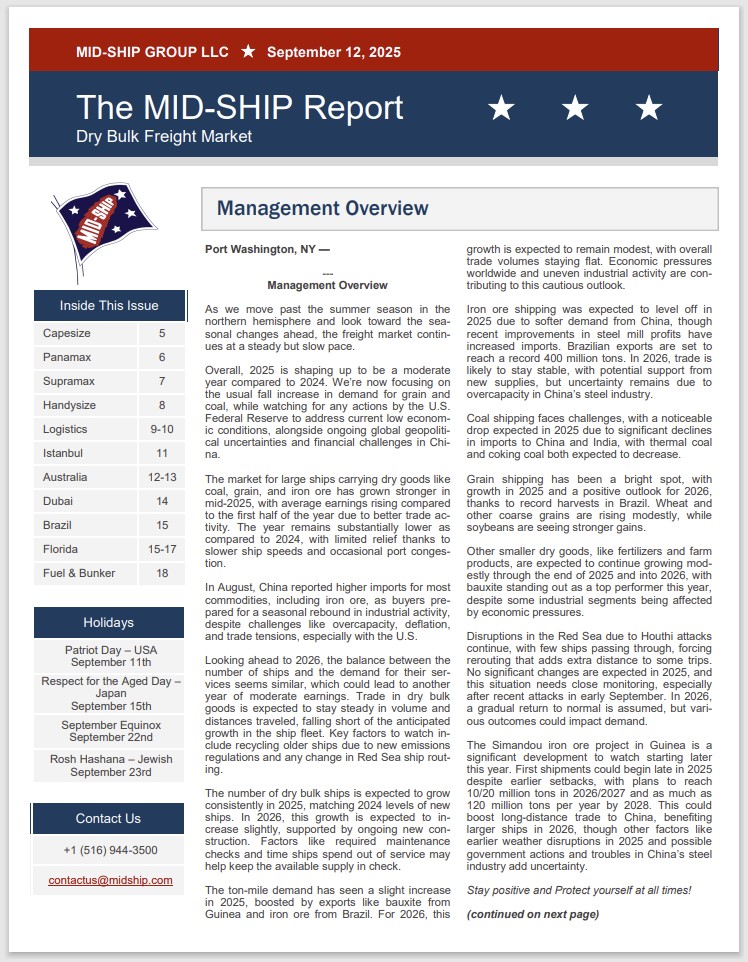
MID-SHIP Report: Dry Bulk Freight Market – September 12 2025

September 12, 2025
Fundamentally, the market remains consistent with early 2025 conditions, characterized by a mature commodity cycle and potentially reduced volumes of both major and minor bulks, uncertainty due to geopolitical risk (Russia-Ukraine, Gaza, India-Pakistan), and the U.S. government’s global trade negotiations. The vessel fleet continues to grow moderately.
The largest vessels are enjoying a favorable supply-demand balance in 2025. The Cape size fleet growth is projected to be minimal this year, while ton-mile demand growth is expected to be above 3%. The Baltic Dry Index (BDI) and Cape size-specific indices are expected to remain volatile, with stronger performance in Q3 due to seasonal commodity demand but potential softening in Q4 if economic headwinds intensify. Projects like Guinea’s Simandou and West Australia’s Onslow enhance long-haul trade prospects. The benchmark route from Brazil to China is reported at over $24.00 per ton and heading north, as compared to $18.20 this time last month.
The Panamax market has been under pressure during the month of May, declining from $12,400 to $10,000 on average in the month. Fortunately, at least now, perhaps on a tailwind from the firm Cape market, but more likely strong demand for grain shipments originating in the Atlantic, both trans-Atlantic and Front Haul, and a pick-up in USEC to India Coal trades. China’s slowing demand has been driving Panamax rates in the Pacific down by 50% since April when prospects within the basin were significantly brighter. Now, Panamax is at parity in both basins.
The Supramax/Ultramax segment of the market has entered a more subdued phase after a previously bullish stretch. The U.S. Gulf, which had been a bright spot with Trans-Atlantic and petcoke runs commanding robust returns, is now showing signs of cooling. A growing number of open ships and a narrowing spread of viable cargoes are beginning to weigh on rates. Early June optimism has given way to a more measured outlook, with forward sentiment pointing to a softer second half of the month. A widening gap between vessel supply and cargo demand is becoming increasingly apparent in the Asia-Pacific region. While North Pacific rounds have held steady, Southeast Asia continues to lag behind expectations. Indonesian coal exports remain subdued as China’s push to stockpile more domestic coal while curbing imports has affected demand and added pressure to rates.
Since our previous report, the Handy size dry bulk market has remained subdued across both the Atlantic and Pacific basins, with limited fresh inquiries and an oversupply of prompt tonnage. While select submarkets have experienced modest gains, overall activity has been restrained. The positive momentum highlighted two weeks ago has persisted, with the U.S. Gulf maintaining its strength. The South Atlantic market has remained steady to firm, underpinned by balanced supply and demand dynamics. Activity in the Continent has been curtailed by national holidays. The Pacific market has held steady, though sentiment is softening due to a growing buildup of vessels in key loading areas. The North Pacific (NOPAC) saw increased activity this week, with rates edging slightly higher.
Cape size remains firm to end the current week, expect volatility nearby, and then look for directional trend as we approach the annual pre-winter restocking in China. The market began the week on a positive footing, with the BCI 5TC gaining $699 to close at $26,156. In the Pacific, sentiment was underpinned by three miners actively in the market alongside some fresh operator cargoes.
The Atlantic basin is leading in the Panamax market, trading at a 60% premium over the Pacific. The China/U.S. trade negotiations continue to be at the top of the minds of owners and operators in the sector. U.S. grain exporters have shifted their focus toward European buyers. The Pacific market has seen modest gains since early summer, rising from $11,000 to around $13,000 per day, with a short-lived peak of $15,000 in mid-July. On the period front, deals remain scarce, with shipowners reluctant to commit beyond a few months.
Supras and Ultras, while starting the new week in a relatively subdued manner, have been firm and continue to enjoy solid demand and a firm trend across all markets. We expect positional volatility to continue due to the finely balanced supply and demand this year.
The Handy-size markets continue to follow their “slow and steady” winning strategy. The market has recently traded up within a narrow range, repeating this aspect each week during the past several weeks. Strong grain exports continue to underpin this market.
Subscribe below to receive the full report.