MID-SHIP Report: Dry Bulk Freight Market – May 7, 2026

May 7, 2026

The days when freight markets could be neatly explained by the balance between cargo volumes and vessel supply seem increasingly distant. In today’s environment, that simplicity continues to give way to a more complex reality. Structural shifts in global trade, combined with persistent geopolitical disruption, are reshaping what might otherwise be a stable and predictable market. Increasingly, the key driver is not just how much cargo is moving, but how far it must travel… and that dynamic is proving to be a powerful source of underlying demand and resilience.

Since our last update, the importance of distance-driven demand has become even more pronounced across all major shipping sectors. While global seaborne volumes remain healthy, approaching 13 billion tonnes, the real story lies in tonne-mile growth. Cargoes are moving farther than ever, with average voyage distances now exceeding 5,200 nautical miles and continuing a more than decade-long trend of expansion. With average haul lengths up roughly 10% since 2019 and still rising, effective vessel supply is being steadily absorbed. Longer voyages translate directly into more days at sea, tightening fleet availability and supporting earnings, even where volume growth itself remains relatively modest.

These dynamics are being reinforced by ongoing structural changes in global trade flows. U.S. energy exports continue to push deeper into Asian markets, while Guinea’s bauxite trade has introduced significant long-haul demand into China. At the same time, disruption remains a defining feature of the current cycle. The reconfiguration of oil and grain trades following the Ukraine conflict, shifting sourcing patterns in agricultural markets, continued security concerns in the Red Sea forcing rerouting via the Cape, and ongoing inefficiencies at the Panama Canal are all contributing to longer and less efficient trade routes. The cumulative effect is clear: capacity is tightening not because there are fewer ships, but because those ships are being required to do more work over greater distances. It is therefore notable that the majority of tonne-mile demand growth this decade has been driven by distance rather than incremental cargo volume.

Against this backdrop, geopolitical risk, particularly in key energy corridors, continues to inject volatility into both freight and fuel markets. The situation in and around the Strait of Hormuz remains highly fluid. While the recent pause in U.S.-led escort initiatives has temporarily softened crude pricing, the broader situation remains unresolved, with the blockade still in place and tensions elevated. This ongoing uncertainty is forcing owners and charterers alike to factor in potential routing changes, heightened insurance exposure, and bunker cost volatility. The result is a market that remains highly reactive, where sentiment can shift quickly, and forward visibility is limited.

Taken together, these forces highlight a market increasingly defined by inefficiency… albeit one that is, somewhat counterintuitively, supportive to freight. Longer routes, congestion, and geopolitical friction are collectively driving higher utilization and underpinning rates across the board. At the same time, industry participants are grappling with a growing sense that traditional forecasting and risk models are struggling to keep up with the pace and complexity of change, particularly as fleet segmentation, regulatory pressures, and fuel uncertainties add further layers of complication.

Looking ahead to the summer months, the outlook can best be described as cautiously constructive. On the dry bulk side, seasonal demand combined with persistent congestion – both at key canals and within congested port systems – should continue to support utilization levels. Additionally, any further escalation or even prolonged uncertainty surrounding the Iran situation is likely to sustain inefficiencies across energy and commodity trades, indirectly tightening vessel supply. While volatility will undoubtedly remain a defining feature of the near-term market, the underlying fundamentals point toward a bias for firmer conditions. As such, we expect a conservatively bullish environment through the summer period, with pricing supported by distance-driven demand, sustained disruption, and an operating landscape that continues to favor inefficiency over equilibrium.


Subscribe below to receive the full report.

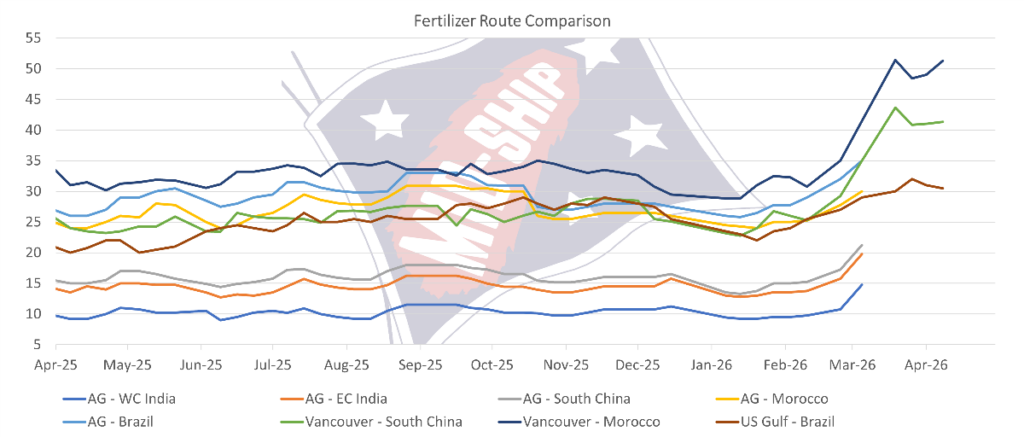
MID-SHIP Fertilizer – May 7, 2026

General Market Overview: 

The dry bulk market delivered a mixed performance, with divergent trends across segments. In Handysize, conditions remained subdued overall, with the BHSI edging up just 3 points to 824 and the 7TC average ticking higher by $54 to $14,828, as weak demand in the Continent and Mediterranean continues to pressure owners toward ballasting or softer rate expectations, while the South Atlantic and US Gulf saw limited fresh inquiry and Asia remained quiet amid holiday disruptions, leaving the sector lacking clear direction. The Supramax market showed signs of stabilization with a positional tone, as improving enquiry in the South Atlantic lifted sentiment, albeit partially offset by a more mixed US Gulf where transatlantic flow slowed; still, fixtures such as the Future achieving upper $19,000s for a grains run helped support a modest rise in the 11TC to $19,136. Panamax markets were firmer, with improving sentiment in both basins as tightening tonnage and stronger fronthaul demand-particularly on NC South America routes…pushed owners to test higher levels, while active Asian export programs and visible period activity further supported the rally, lifting the P5TC by $726 to $19,216 alongside notable fixtures in the Atlantic at improving returns. Capesize extended its strong upward momentum, with robust activity in both the Pacific and Atlantic driving the BCI 5TC sharply higher to $46,017 amid tightening tonnage and firming bids across key routes.

Looking ahead to next week, the market is likely to remain uneven, with Capesize strength potentially spilling over into larger segments if current momentum holds, while Panamax could continue its upward trajectory on firm grain and mineral demand; however, Handysize and Supramax may struggle to gain meaningful traction unless fresh inquiry improves. Broader sentiment will be increasingly sensitive to geopolitical risk, particularly the ongoing conflict involving Iran, which could disrupt key trade flows and energy markets…potentially supporting freight rates through longer-haul diversions and supply-side inefficiencies, but also introducing volatility and caution among charterers that may temper activity in the near term.


Subscribe below to receive the full report.


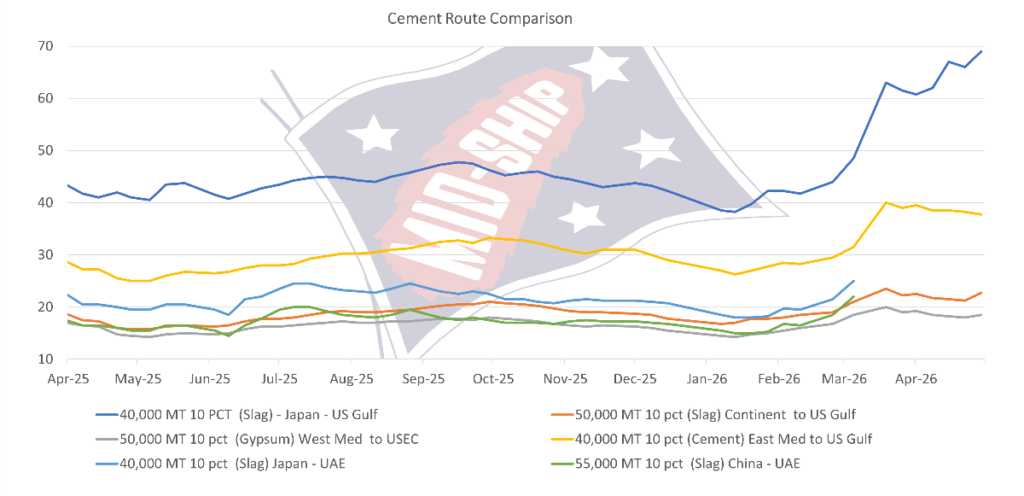
MID-SHIP Cement Report – April 30, 2026

April 30, 2026

Market Overview: 

Handysize and Supramax markets generally lost momentum as holidays across Asia and the upcoming Labour Day curtailed activity. In the Supramax segment, both basins were subdued with limited fresh enquiry, though spot indications in Asia remained workable despite the lack of volume, highlighted by a Tianjin open fixed to Sri Lanka at $23,000. The Supramax 11TC eased slightly to $19,391, reflecting the slower tone rather than any sharp shift in fundamentals. Handysize conditions were more mixed, while Continent and Mediterranean markets stayed soft, the US Gulf and South Atlantic continued to benefit from steady enquiry, gradually pushing rates higher. The Pacific remained firm on limited tonnage availability, with the BHSI edging higher to 811 and the 7TC averaging $14,597, supported by a trickle of fresh fixing activity.


Subscribe below to receive the full report.
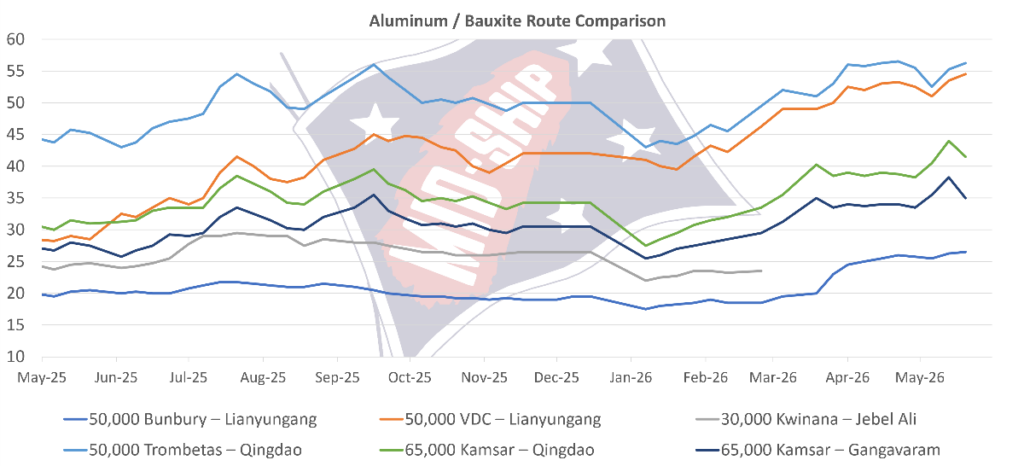

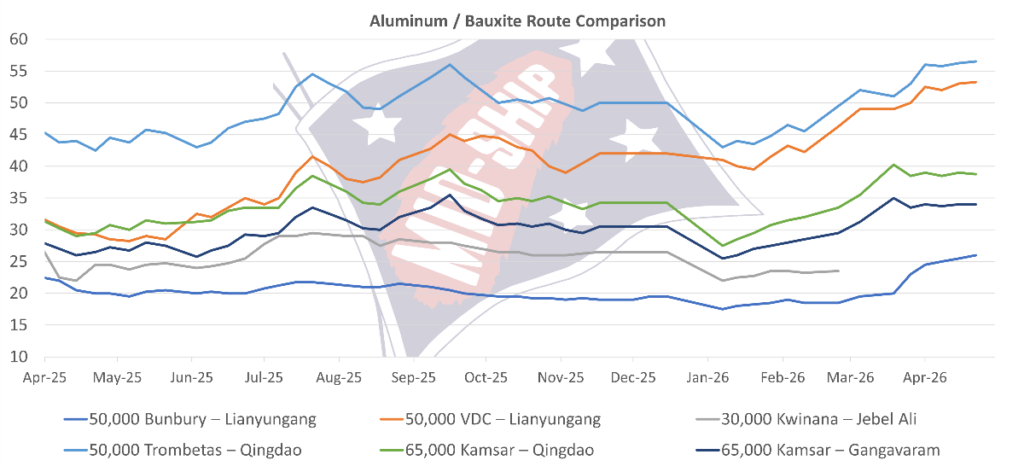
MID-SHIP Alumina/Bauxite – April 22, 2026

April 22, 2026

Market Overview: 

Supramax/Ultramax and Handysize markets remained the main bright spots midweek, with activity levels and sentiment generally constructive. In the Supramax/Ultramax segment, Atlantic trading was a touch softer as limited fresh inquiry from the Continent and Mediterranean pushed owners to seek cover elsewhere, creating some drag on US Gulf rates, while East Coast South America held broadly steady with balanced supply and demand. By contrast, the Pacific continued to show healthier momentum, with solid coal, mineral, and regional repositioning demand supporting firm fixtures and pushing the Baltic Supramax Index up to 1,484. Handysize sentiment was similarly well supported, despite limited reported fixtures; rates in the US Gulf and ECSA continued to firm, and ample fresh inquiry across the Asian basin kept owners confident, reflected in the Baltic Handysize Index edging up to 781.

In the Panamax sector, Atlantic grain runs continued to command a premium over ore, although overall rates remained capped by ample tonnage-particularly in the North Atlantic-while ECSA eased marginally on last done levels despite healthy NCSA inquiry. In the Pacific, a steady flow of NoPac, Indonesian, and Australian cargoes helped absorb supply and prevent oversupply, even as the Baltic Panamax Index slipped slightly to 1,971. Capesize markets were mixed, with firmer North Atlantic demand offsetting softer conditions in the South Atlantic and Pacific, where declining C5 levels contrasted with a higher Baltic Capesize Index close at 4,356.


Subscribe below to receive the full report.

MID-SHIP Report: Dry Bulk Freight Market – April 15, 2026

April 15, 2026

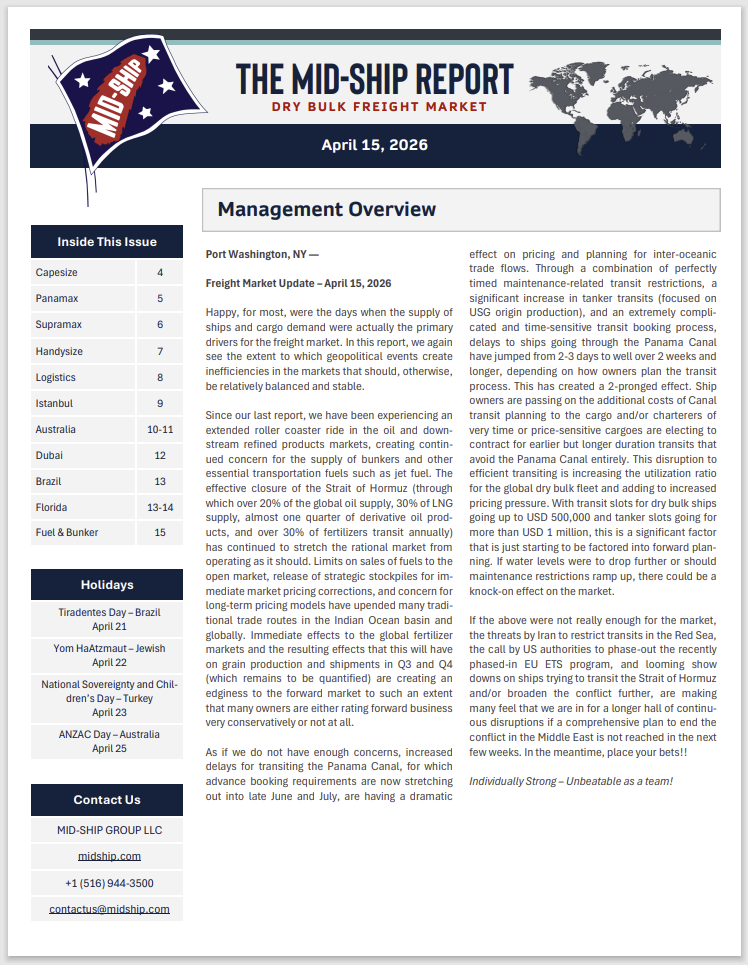
Happy, for most, were the days when the supply of ships and cargo demand were actually the primary drivers for the freight market. In this report, we again see the extent to which geopolitical events create inefficiencies in the markets that should, otherwise, be relatively balanced and stable.

Since our last report, we have been experiencing an extended roller coaster ride in the oil and downstream refined products markets, creating continued concern for the supply of bunkers and other essential transportation fuels such as jet fuel. The effective closure of the Strait of Hormuz (through which over 20% of the global oil supply, 30% of LNG supply, almost one quarter of derivative oil products, and over 30% of fertilizers transit annually) has continued to stretch the rational market from operating as it should. Limits on sales of fuels to the open market, release of strategic stockpiles for immediate market pricing corrections, and concern for long-term pricing models have upended many traditional trade routes in the Indian Ocean basin and globally. Immediate effects to the global fertilizer markets and the resulting effects that this will have on grain production and shipments in Q3 and Q4 (which remains to be quantified) are creating an edginess to the forward market to such an extent that many owners are either rating forward business very conservatively or not at all.

As if we do not have enough concerns, increased delays for transiting the Panama Canal, for which advance booking requirements are now stretching out into late June and July, are having a dramatic effect on pricing and planning for inter-oceanic trade flows. Through a combination of perfectly timed maintenance-related transit restrictions, a significant increase in tanker transits (focused on USG origin production), and an extremely complicated and time-sensitive transit booking process, delays to ships going through the Panama Canal have jumped from 2-3 days to well over 2 weeks and longer, depending on how owners plan the transit process. This has created a 2-pronged effect. Ship owners are passing on the additional costs of Canal transit planning to the cargo and/or charterers of very time or price-sensitive cargoes are electing to contract for earlier but longer duration transits that avoid the Panama Canal entirely. This disruption to efficient transiting is increasing the utilization ratio for the global dry bulk fleet and adding to increased pricing pressure. With transit slots for dry bulk ships going up to USD 500,000 and tanker slots going for more than USD 1 million, this is a significant factor that is just starting to be factored into forward planning. If water levels were to drop further or should maintenance restrictions ramp up, there could be a knock-on effect on the market.

If the above were not really enough for the market, the threats by Iran to restrict transits in the Red Sea, the call by US authorities to phase-out the recently phased-in EU ETS program, and looming show downs on ships trying to transit the Strait of Hormuz and/or broaden the conflict further, are making many feel that we are in for a longer hall of continuous disruptions if a comprehensive plan to end the conflict in the Middle East is not reached in the next few weeks. In the meantime, place your bets!!


Subscribe below to receive the full report.
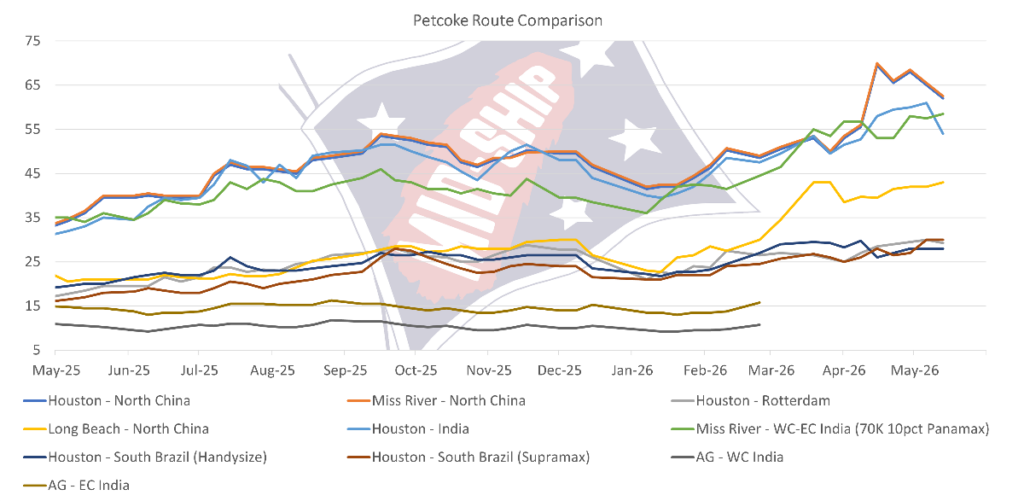

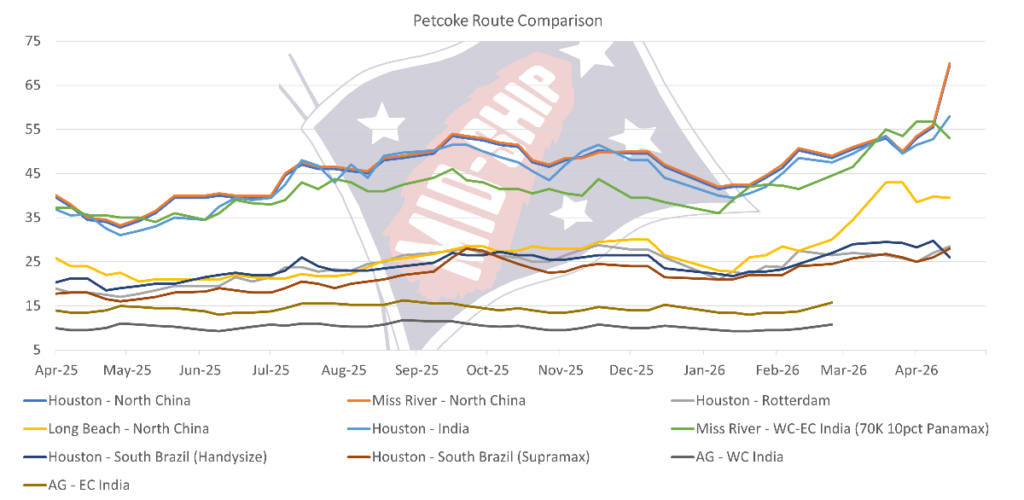
MID-SHIP Petcoke Report – April 15, 2026

Market overview:  

Dry bulk markets strengthened further across all sizes, led by continued firmness in the Handysize and Supramax sectors. Handysize sentiment improved globally despite mixed activity, with continental markets steady, the Atlantic showing firmer forward indications, and Asia benefiting from stronger demand and tightening tonnage, lifting the 7TC to $12,875. Supramax performance was driven by robust US Gulf enquiry, where Ultramax levels were said to be approaching the mid $20,000s, while Asia maintained healthy NoPac and backhaul demand amid prompt tonnage tightness; the 11TC advanced $342 to $17,330.

Panamax markets also moved higher, supported by firmer bids and steady cargo flows from EC South America, Australia, and Indonesia, with improving fixing levels in Asia encouraging period interest and pushing the P5TC up $427 to $17,528, while the Capesize market surged on strong Pacific miner demand and tightening Atlantic supply, driving the BCI 5TC sharply higher to $35,953.


Subscribe below to receive the full report.

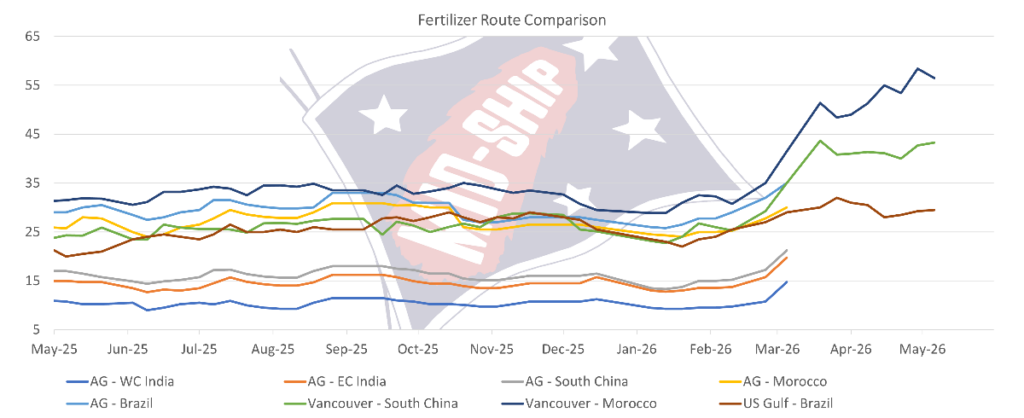
MID-SHIP Fertilizer – April 8, 2026

April 8, 2026

General Market Overview: 

Handysize: The Handysize market endured another subdued session, with index levels edging lower amid limited fresh activity, as lackluster conditions persisted across the Continent and Mediterranean and continued tonnage overhang in the US Gulf kept rates under pressure, while the South Atlantic remained firmer on tight April availability and Asia held a broadly balanced tone with charterers and owners cautiously marking expectations higher.

Supramax: Sentiment remained quietly positive despite limited reported fixtures, with increasing enquiry from the US Gulf lending underlying support, modest but improving signs emerging in the South Atlantic, and Asia continuing to apply upward pressure on rates as both spot and period activity reflected a gradually strengthening backdrop.

Panamax: The Panamax market showed steady gains across both basins, with Atlantic routes supported by healthy trans-Atlantic and fronthaul demand and Asia underpinned by tight nearby tonnage and a consistent flow of NoPac and Australian cargoes, giving the sector a broadly balanced and constructive feel.

Capesize: Capesize posted a further firming, with the index advancing on steady Pacific miner activity within a tight trading range while the Atlantic lagged on limited fresh impetus, all against the backdrop of sharply softer bunker prices following the ceasefire announcement and a pullback in crude oil.

Macro / Geopolitical Overlay: Broader shipping sentiment continues to be shaped by the tentative US-Iran ceasefire, which has eased oil prices materially and opened the possibility of a gradual increase in traffic through the Strait of Hormuz, though transit levels remain far below normal and owners continue to exercise caution, with a significant volume of bulkers still effectively held in the Gulf and uncertainty around the durability of the ceasefire tempering expectations of a rapid normalization.


Subscribe below to receive the full report.


MID-SHIP Cement Report – April 1, 2026

April 1, 2026

Market Overview: 

Supramax conditions improved overall, with gains seen across most loading areas and the 11TC average rising to $15,476 as South Atlantic and US Gulf fundamentals remained supportive, while Asian activity stayed steady. The Handysize sector, by contrast, was largely unchanged, with subdued enquiry across the Continent and Mediterranean, softer conditions in the US Gulf, and a more balanced but quiet picture in Asia, leaving the 7TC marginally lower at $12,508.

The Panamax market lost some momentum as participants stepped to the sidelines ahead of the long weekend, though underlying Atlantic fundamentals remained constructive. South Atlantic and trans Atlantic demand continued to absorb tonnage, drawing interest from owners positioned further afield, while limited fresh enquiry from South Asia and the North Pacific capped further upside. Period activity remained firm, with modern tonnage securing mid $19,000s for one year employment, and the 5TC finishing the week higher at $16,053, reinforcing the broadly stable outlook despite mixed Pacific sentiment.

Capesize rates edged modestly higher into the end of the week, supported by a tightening tonnage list in both basins and intermittent miner activity in the Pacific, with the BCI 5TC closing at $27,991 despite quieter pre holiday trading and continued bunker price volatility.

Noteworthy Highlights
• South Atlantic continues to outperform across Panamax and Supramax segments, attracting vessels from further afield
• Atlantic Capesize supply tightening as West Africa–China demand draws vessels north
• Pacific Panamax rates remain under pressure amid limited NoPac enquiry
• Period market remains active, particularly for modern Panamax and Supramax units
• Bunker volatility persists, with Brent rebounding above $105, adding cost uncertainty to Q2 positioning


Subscribe below to receive the full report.

MID-SHIP Report: Dry Bulk Freight Market – April 1, 2026

If a person did not know where or what the Strait of Hormuz was 4 weeks ago, they definitely know where it is by now as well as the impact that it is having on the world economy and daily life for the majority. Many of us have started to use the acronym “SOH” in daily correspondence given the number of times it is referred to.

While there are a limited number of ships still transiting the SOH daily with Iranian clearance/right of safe passage,  only a fraction of the goods normally transiting the Strait continue to do so. Most/all ships receiving safe passage belong to jurisdictions that have approached Iran as either sympathetic to their position or have a strictly neutral position in the hope of assisting to resolve the conflict.  A considerable focus is on getting ships trapped in the Arabian Gulf out so that outbound cargoes can be delivered to market and to free up non-tradeable assets while they sit in hostile waters waiting for a resolution. The impact to the reduction of trade has had considerable effects on the global oil, LNG, aluminum, steel and fertilizer industries. Even less obvious trades such as that for helium have been impacted.

While both Saudi Arabia and the UAE have been successful in expanding alternative logistics routes that mitigate ships having to transit the SOH (ie the Red Sea and Arabian Sea respectively), there is a limit to the volumes that can be redirected. Also, other economies, ie Bahrain and Qatar, are effectively cut off from world trade for the duration of the conflict – at least for now.

Bunker fuel costs continue to be the big question mark to ship owners pricing forward cargoes. Without a secure bunker option and price for available supply, ship owners are holding back on rating new business firmly. Oil prices have continued to swing violently as news out of Washington, and other players in the conflict, either indicate an escalation of action or the belief in a quick resolution. If the conflict continues into April and May, there is speculation that oil could rise to closer to USD 150 per barrel in spikes with the floor being closer to USD 90 and an average pricing being closer to USD 115/120 until the SOH transit is resumed for oil tankers. In this scenario, refined products (including bunker fuels) could see pricing rise by up to 200% of pre-war levels.

When tracking actual market rates for dry bulk cargoes, while there is neutral to positive sentiment for the larger carrier segments – cape and panamax – rate increases across the board have mostly been a result of the fuel price increases or direct trading limitations being created by the war. Remember that only about 3% of global dry bulk trade transited the SOH before the war so the global impact to supply of ships is not driving the pricing needle. Rather, we are seeing the rebound in coal pressing forward modest gains for the larger segment ships aided by modest increases in iron ore movement for increased steel production requirements. The trend for smaller bulk trades has been weaker, particularly in the Atlantic, resulting in flat to slight decreases for vessel pricing in the Supra and Handy segments. Many in the minor bulk trades see the increased transportation (ie fuel) costs reducing their ability to transport cargo for long-haul trades in favor of shorter regional trades that make better sense for CFR pricing on expensive base products. This in turn reduces vessel utilization and causes rates to sag a bit.

A big concern for the forward market remains how the world fertilizer markets (and the resulting grain harvests), will manage with a 40% reduction in sulphur and urea supply as a result of the SOH closure. This supply crunch could see a major redirection or increase in seaborne shipments in Q3/Q4 2026 and we have to watch that space closely. Similarly, if the conflict were to be quickly resolved, we could expect to see a rapid market resurgence as trades become possible/viable again and we seen trades that have been slow rebound.


Subscribe below to receive the full report.


MID-SHIP Alumina/Bauxite – March 26, 2026

March 26, 2026

Market Overview: 

The dry bulk market presented a mixed picture midweek, with Panamax and minor bulk segments under pressure while Capesizes showed tentative improvement. Panamax activity softened across both basins as charterers relied on in house tonnage and fresh inquiry thinned, particularly in the Atlantic. Pacific sentiment remained cautious with limited new business, although North Pacific trading held steady, and Australia/India saw marginally better inquiry without rate support. The Baltic Panamax Index fell sharply to 1,796. Supramax and Handysize markets also experienced subdued conditions, weighed down by long tonnage lists and limited demand, with both indices edging lower amid continued sensitivity to bunker availability and pricing.

By contrast, the Capesize sector edged firmer overall despite ongoing softness in parts of the Pacific. Atlantic iron ore routes provided support, with the key Brazil–China trade fixing around the low $30s per tonne and the Baltic Capesize Index rising to 2,915. However, Pacific rates eased slightly as the West Australia–China business slipped to the mid $10s per tonne amid growing tonnage availability and limited miner participation. While Capesizes are showing early signs of stabilization, the broader market tone remains cautious, with most segments still searching for clearer demand signals before any sustained recovery can take hold.


Subscribe below to receive the full report.