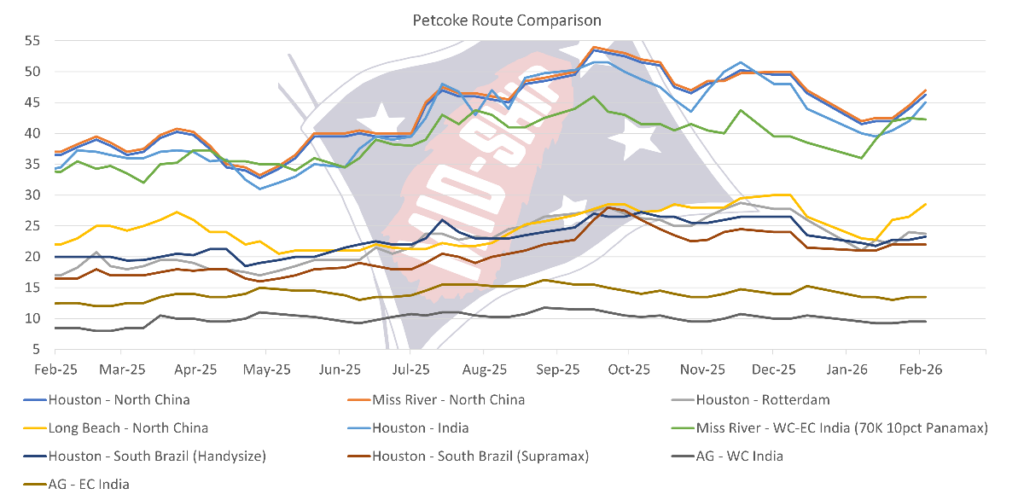
MID-SHIP Petcoke Report – March 19, 2026

March 19, 2026

Market overview:  

Handysize: ▼
Handysize markets continued to drift, with subdued activity and softening sentiment evident across both basins. The Continent and Mediterranean held largely steady, while the South Atlantic and U.S. Gulf remained pressured by thin cargo availability. In the Pacific, owners showed pockets of resistance, but uncertain demand capped any upside, keeping rates broadly rangebound. Fixture flow was limited, with most reported business concluded on subjects and offering little signal of near-term improvement.

Supramax: ▼
Supramax conditions remained under pressure, with limited fresh enquiry and a lack of volume continuing to weigh on rates across most regions. The U.S. Gulf and South Atlantic saw little new business, pushing rates below recent benchmarks, while the Continent–Mediterranean remained flat amid muted interest. In Asia, sentiment stayed weak as tightening cargo volumes, increasing vessel availability, and high bunker costs curtailed upside. One longer-haul fixture from South Africa to China provided a brief highlight, but overall market direction remains defensive.

Panamax: ▲
The Panamax market showed clear signs of strengthening, led by improved demand in the Atlantic for both fronthaul and transatlantic business, allowing owners to defend firmer rate ideas despite an otherwise balanced tonnage list. Index gains across the Atlantic routes underlined the improved tone, while Asia followed suit, supported by stronger cargo flows from Indonesia into India. Fixture activity was steady across both basins, with multiple vessels reported fixed or on subjects for fronthaul, round-trip, and grains employment, reinforcing the view of gradually improving momentum.

Capesize: ▼
Capesize sentiment cooled as the market consolidated, with transpacific weakness offsetting firmer transatlantic and fronthaul activity.


Subscribe below to receive the full report.

MID-SHIP Report: Dry Bulk Freight Market – March 18, 2026

March 18, 2026

As we enter the 4th week after the start of the War in Iran, the volatility and disruption anticipated in our last report have come to pass. Global developments are requiring a day-by-day reassessment of how ocean freight is planned and priced given the difficulty keeping pace with the changes that are creating structural concern to how freight pricing can be realistically managed for short term business execution. The obvious first point of concern/cause is bunker costs and availability.

Since the start of military action in late February, prices for delivered bunkers have more than doubled in most primary bunker supply locations. With the price of oil swinging violently between USD 90 and USD 115  in recent days, the expectation is that this price pressure will continue and get worse before things calm down. Despite US efforts to stabilize pricing/supply and calls for the provision of safe passage, the Strait of Hormuz remains effectively closed to all ships other than those few the Iranians have allowed to transit unmolested. Major suppliers of bunker fuels have warned of tightening supplies and a limitation on how far forward or how much volume they will be willing to supply in coming weeks. East Asian economies, including Japan, Korea and China, fearing supply constraints, have set limits on fuel exports which include jet fuel and bunker supplies. As more disruption is caused to oil refining in the Middle East, highlighted now by the targeting of oil production assets on both sides of the conflict, this concern will likely continue to escalate.

The US decision to temporarily suspend Jones Act requirements, for US flagged ships in coastal trade, is but one of many reactions to the concerns around reliable energy supplies. Given the limited duration of the waiver (60 days) it is unlikely this will have much of an effect on market pricing and the reaction to this may be dampened by the fact that foreign flagged oil carriers are now higher priced in the market than comparable US flagged assets (a reversal from the norm). The waiver is symbolically important though commercially limited.
The freight market reaction to these developments has been mixed. While fuel increases have caused voyage charter rates to rise dramatically, the underlying demand for dry bulk ships remains relatively weak with many trades being idled due to the conflict or, more so, to the increased costs of spot chartering.  We have not seen a “pop” in market pricing (outside the conflict areas), predicted by some, as many traders look to temporize shipments in the face of growing uncertainty. However, before writing off the freight market, please recall what happened after COVID restrictions were lifted and again in 2025 once trade and shipping policy with the USA became more settled. The period of uncertainty was followed by a strong resurgence of demand and a resulting stronger freight market to clear off the backlog of cargoes to be moved.

With everything we are seeing in the space above, there are other market developments, which would have been front page news in quieter times, that are now coming in under the radar. Last week, the Chinese authorities began imposing much more intensive inspections on Panamanian flagged, likely in retaliation for Panama revoking terminal concessions held by Hutchinson Whampoa.  Between March 8-12 approximately 30 Panamanian flagged ships had been detained making up about 80% of all detentions in China over the same period. If this continues, it will possibly create an added supply disruption as it will take time for these ships to be cleared of deficiencies and return to general service. Given the number of ships under sailing under the Panama flag, the implications could be a sizeable disruption to the Pacific market. Time will tell.

We repeat our hopes that this conflict may be resolved as quickly as possible. First and foremost for the innocent people unrightfully caught in the middle and, secondly, so that we can return to some form of normalcy in the way supply and pricing is managed. We think we could all enjoy a truly boring month for a change.


Subscribe below to receive the full report.

MID-SHIP Report: Dry Bulk Freight Market – March 5, 2026

March 5, 2026

Over the weekend we all woke to the news of yet more military action in the Mideast which sets the hard and pervasive tone for this market update. First and foremost, we want to express our support and our thoughts to all those in the shipping and trading communities directly affected by these actions including our own staff in Dubai who have been sheltering in place since retaliatory strikes started earlier this week. It is our hope that  a quick resolution can be found allowing everyone in the region to get back to living life normally.

Given the last comment, the big question in the market driving many decisions right now is “how long will it take for the military actions to end”? Initial estimates from Washington indicated 4-5 weeks of direct action, but given the regional implications and breadth of actions, many others feel this could become a more prolonged state of reality for the markets for a while. It would be in everyone’s best interests for this to be resolved quickly.

Among the major direct impacts that the freight markets have faced since Saturday are the following:
-WTI oil pricing has risen to over USD 80 a barrel and this has driven up the prices for bunker fuels by more 30% so far.
-The Strait of Hormuz, through which more than 20% of the world’s oil is transported, is effectively closed to commercial shipping as Iranian retaliatory actions have targeted non-military targets in the region including commercial ships through the waterway, which Iran has claimed they control (though there are rumors several Chinese owned ships have been given permission to transit unaffected).
-War Risk Insurance coverage has been revoked for ships trading in the Arabian Gulf forcing ship owners to purchase new insurance at what is reported to be 4-5 times the cost of the insurance previously. War risk coverage in many cases is not being offered for vessels passing through the Strait of Hormuz.
-War Risk premiums have been assessed for all ships trading from Western Pakistan down to Somalia including  the Red Sea.
-As also happened when the Ukrainian War started, a large number of ships are basically trapped in the Arabian Gulf (enroute to load or discharge) and, for the time being, will be temporized  assets in vessel supply evaluations.

Much of these results can be clearly calculated into the markets and resulting pricing but there are a lot of factors that are making the glass ball more opaque. The Chinese government, the 3rd largest exporter of processed fuels, has announced a ban (temporary?) on fuel exports given the concerns about future oil supplies for their economy, It is reasonable to expect that all major markets dependent on imported energy needs will face the same or similar pressure and this, along with physical supply constraints, will likely keep fuel pricing rising over the coming days.

Going into this new round of extra market dynamics, many traders and shipping entities had found the freight market to be balanced but fragile. General supply of ships was solid but demand was spotty and many recent government initiatives had taken away the visibility of how normal trade flows would progress. This created a lot of volatility. What is for certain is that the actions in and around Iran will exacerbate that volatility in the next weeks. Because of this, many major ship owners have taken the position that they will not readily rate forward business and any pricing given will be for short reply time.

For many businesses operating in tight pricing dynamics, this is a problematic way of trying to move forward. It will likely slow down transactions being finalized and create concern on tight-margined business.

Trade into and out of the Mideast is basically temporized and this will greatly affect the aluminum, steel, fertilizer and petcoke markets (input and output) among others. We will need to see how replacement trades develop over the next few weeks to really assess how much of an impact this will have to vessel pricing as alternative sources are tapped. How will this play into already weak housing markets, particularly in China, and the economic impact prolonged higher fuel pricing will generate? That is a bigger picture it (as are many others) that will flesh out over the coming weeks. We sincerely hope it is weeks and not months before we see a practical resolution.


Subscribe below to receive the full report.

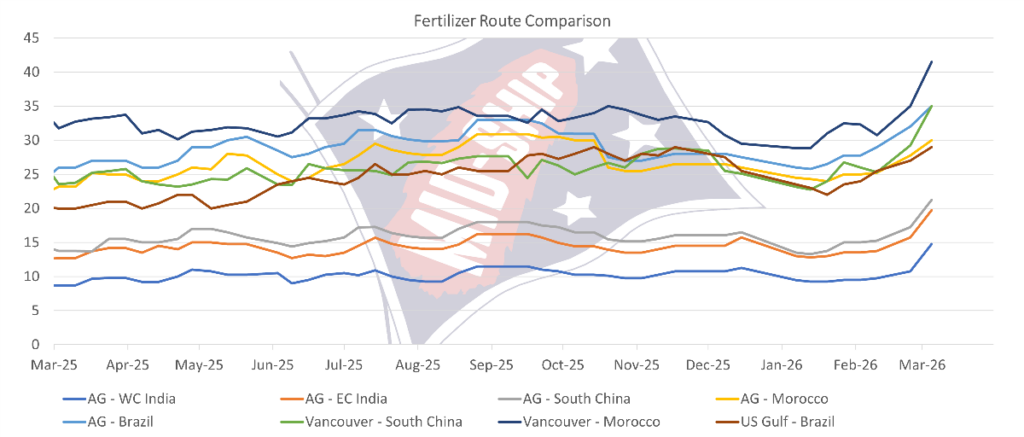
MID-SHIP Fertilizer – March 5, 2026

Market Overview:

Handysize trading remained squarely positional, with pockets of firmness emerging particularly in the Atlantic, where the U.S. Gulf and ECSA saw support through the end of March on limited tonnage. The Continent and Mediterranean also ticked higher, reflecting incremental improvements in demand. In the Pacific, sentiment strengthened despite few reported fixtures, though talk circulated of a 38,000 DWT unit securing $12,000 daily for Indonesia–North China business. With fundamentals mixed but generally stable, the Baltic Handysize Index moved up 14 points to 799. Capesizes, meanwhile, continued their upward momentum, with both Atlantic and Pacific major ore routes firming further.

Supramax and Ultramax activity remained steady, though market tone was mixed due to elevated geopolitical risk in the Middle East. In the Atlantic, the U.S. Gulf and ECSA both firmed on the back of decent cargo flow, while the Continent and Mediterranean saw slight upward adjustments, helped in part by increased scrap volumes. Market participants did note rising Indian Ocean ballasters and increasing tonnage counts, tempering bullishness. In the Pacific, sentiment was more cautious as security threats disrupted Persian Gulf cargoes, leading owners to demand premiums for West Coast India-bound business. Despite this, fixtures such as the Amis Brave at $18,000 for a Vietnam–Honduras trip and the Tiger Pioneer at similar levels for a Goa-to-Med run illustrated ongoing trade and a still constructive rate environment. The Baltic Supramax Index added 22 points to reach 1383.

The Panamax sector continued to display a clear East–West divergence, with the Atlantic once again softening under mounting tonnage and a thinning flow of fresh cargo. The Pacific, by contrast, maintained its momentum as tight vessel supply and healthy inquiry supported firmer sentiment. Spot fixtures reflected this divide: Atlantic rounds such as the Ulusoy fixing at $22,250 daily lagged behind a series of mid $22,000s to $23,500 fixtures concluded in the Pacific, including the Taho Virtue and Yangze 26. Period interest also emerged, with Klaveness reportedly taking the Xing Shun Hai for 12 – 14 months at $19,000 daily, signaling cautious optimism but with limited appetite for paying up on duration. Overall, the Baltic Panamax Index rose 23 points to 2002, reinforcing the Pacific-led support.


Subscribe below to receive the full report.


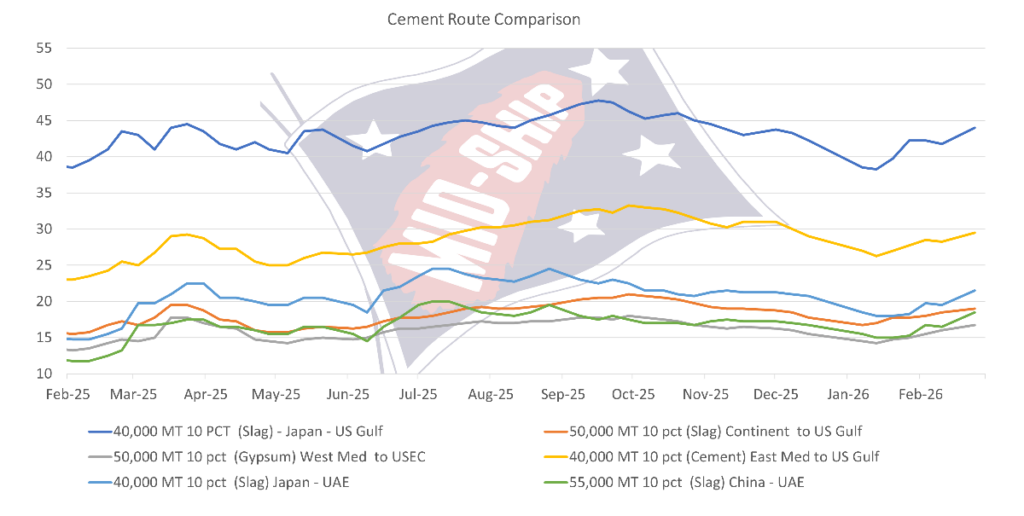
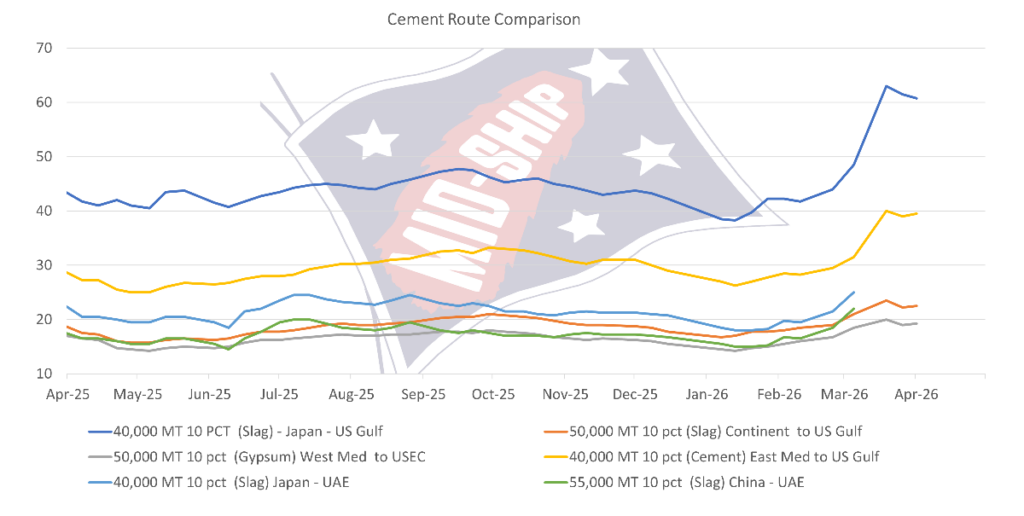
MID-SHIP Cement Report – February 26, 2026

February 26, 2026

Market Overview: 

Dry bulk freight markets delivered a mixed but generally steady performance today, with trends varying across vessel classes and regions. In the Capesize segment, the BCI 5TC eased marginally by $23 to $29,088, reflecting a Pacific market that has largely stabilized. Activity remained consistent, with major miners and operators concluding fixtures in the low to mid $10s range, keeping the C5 index broadly flat at $10.174. The Atlantic was more subdued, particularly ex Brazil and West Africa, where a wide bid offer gap limited concluded business despite a slight uptick in the C3 index. Growing tonnage in the North Atlantic also contributed to softer sentiment. Period interest remained steady, highlighted by Classic’s 11 – 13 month fixture of the NGM Bond at $31,500.

Panamax market dynamics diverged sharply between basins, with Atlantic softness offset by continued strength in the Pacific. In the Atlantic, accumulating prompt tonnage and insufficient fresh enquiry placed downward pressure on transatlantic routes, resulting in a $186 decline in the P1A index. By contrast, the Pacific maintained a firm tone supported by tight vessel supply and healthy demand across Indonesia, Australia, and the North Pacific; this lifted the P3A index by $329. The firmer Pacific environment also supported the backhaul market, where the P4 rose by $300. Period sentiment remained constructive, with the Sakizaya Diamond fixing 11 – 13 months at $17,500, helping the P5TC average rise to $16,793.

The Supramax and Handysize sectors exhibited a more balanced and constructive tone across both basins. Supramaxes saw the 11TC average increase by $485 to $15,382, with stable Atlantic fundamentals complemented by stronger activity in Asia — particularly from the North Pacific and South Indonesia coal trades. Period interest remained present, with the Belforce securing a 4 – 6-month charter at $16,750. The Handysize market also strengthened, with the BHSI adding 13 points to 724 as sentiment improved in both the Continent–Mediterranean and Asian regions. Firmer Pacific demand and tighter tonnage supported a range of spot and short period fixtures, including the Guzide to the Arabian Gulf and multiple forward coverage enquiries across the basin.


Subscribe below to receive the full report.
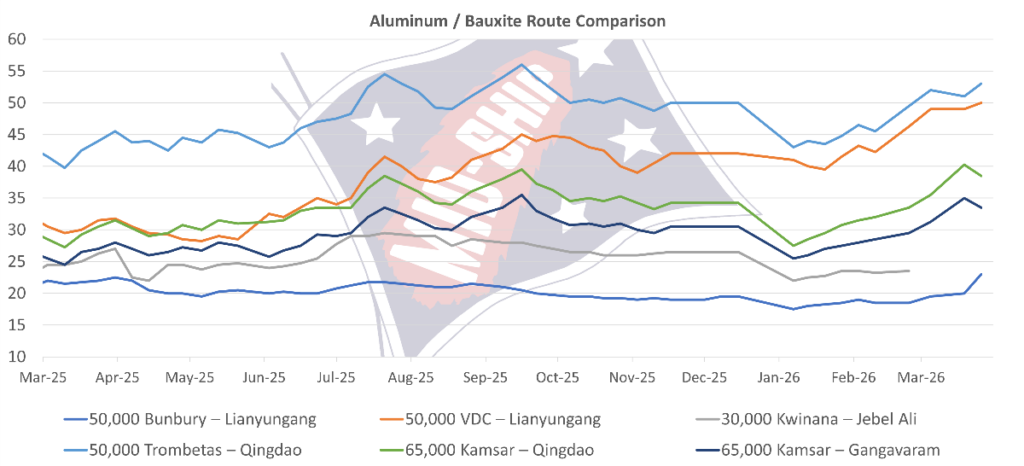

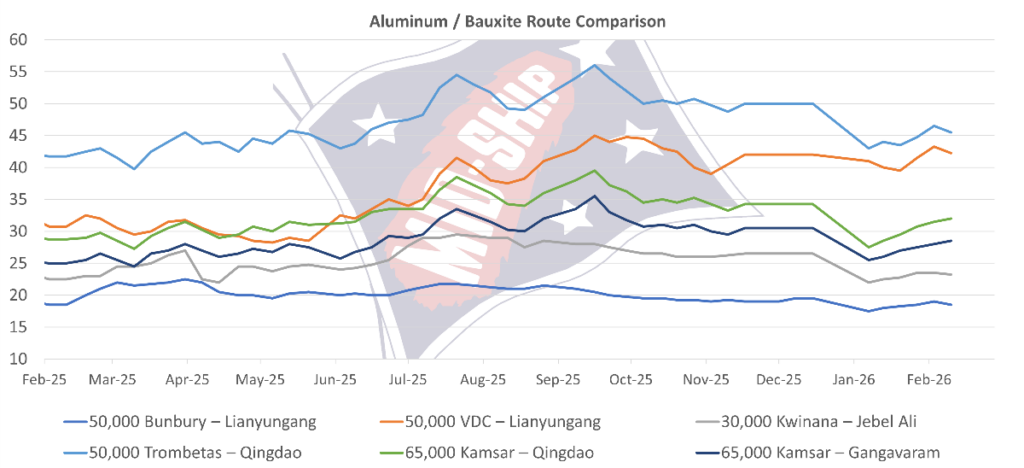
MID-SHIP Alumina/Bauxite – February 11, 2026

February 11, 2026

Market Overview: 

The dry bulk market continued to diverge across vessel segments, with Atlantic strength offsetting softer Asian conditions. Handysizes saw further gains as the BHSI rose to 657, supported by a firm Atlantic, where tight February tonnage and steady trans Atlantic demand kept sentiment positive. Limited inquiry in the Continent and Mediterranean produced only marginal rate adjustments, though fixtures such as the Uni Blossom from Morocco to ECSA at $6,700 underscored underlying stability. Asia, however, remained subdued amid Japanese holidays and persistent weak sentiment. Supramaxes also posted another positive day, driven primarily by a strong Atlantic — especially the U.S. Gulf and South Atlantic — where owners achieved higher numbers, including the Green Genie and Iseaco Grace securing mid $20,000s for ECSA to Med runs. The Continent-Med remained balanced, while Asian markets stayed soft with growing prompt supply and muted fresh inquiry; Indonesian rounds hovered around $10,000 – $12,500 depending on size and delivery. Panamaxes extended their upward momentum across both basins as sentiment improved and fixing volumes increased. The Atlantic saw steady trans Atlantic demand and consistent ECSA grain flows, tightening nearby supply. Pacific activity remained healthy, supported by strong Indonesian short-haul demand and stable Australian and NoPac programs, with fixtures ranging from low $10,000s on SE Asia coal runs to around $17,000 for EC South America fronthaul back to Asia. Capesizes closed the day firmer in both hemispheres, highlighted by gains in the C5TC to $26,432. Atlantic strength was led by improving fronthaul sentiment and several ballaster fixtures from Brazil and Seven Islands, with Tubarao Qingdao trades in the low-to-mid $22s. The Pacific also improved, with major miners fixing West Australia–Qingdao in the low-to-mid $8s, lifting the C5 index to $8.417. Overall, the larger sizes benefited from tightening supply, while smaller segments remained split between a firm Atlantic and a still soft Asia.


Subscribe below to receive the full report.

MID-SHIP Petcoke Report – February 5, 2026

February 5, 2026

Market overview:  

The dry bulk market experienced a subdued session overall to start this week, with activity levels remaining thin across most segments. Sentiment varied by basin, though the Atlantic continued to display comparatively firmer undertones than Asia.

In the Handysize sector, conditions remained quiet, with limited fresh fixing emerging. The BHSI closed at 626, while the 7TC edged higher by $74 to $11,259. In the Continent and Mediterranean, activity was minimal, and the market appeared broadly balanced, with rates marginally firmer than recent levels. By contrast, the U.S. Gulf and South Atlantic continued to show gradual upward momentum, fostering cautious optimism among market participants despite the lack of concrete fixtures. A 37,000 DWT vessel was reportedly fixed by Cargill for a Santos–Croatia voyage at $20,500, although further details were not disclosed. In Asia, trading was muted, with a relatively shorter tonnage list offset by little change in the cargo book.

The Supramax/Ultramax segment saw another information-light day. The Atlantic basin remained relatively buoyant, supported by improving sentiment in several areas, though some participants suggested the U.S. Gulf may be approaching a near-term bottom as fresh fixing data remained scarce. The South Atlantic stayed largely positional, yet modest upward momentum persisted. A 64,000 DWT vessel was heard placed on subjects for an EC South America–Singapore/Japan trip at mid $16,000s plus mid $600,000s ballast bonus, though no confirmation followed. In Asia, brokers described a slower session, with recent gains in the northern regions easing. Period activity provided some support, with talk of a 63,000 DWT open Zhoushan fixing 13 – 15 months in the upper $15,000s. The 11TC average finished the day up $136 at $13,691.

Conditions softened further in the Panamax sector, where the BPI time charter average slipped $220 to $15,515, reflecting a weaker trading day overall. Atlantic sentiment came under pressure as several core charterers remained absent, while limited transatlantic and fronthaul stems circulated. Many charterers appeared well covered through backstops, and tonnage lists lengthened as additional prompt vessels entered the market. Fronthaul demand remained subdued, with mineral fronthaul cargoes being offered at last-done levels but failing to attract interest. In Asia, the market also trended softer, with marginally lower levels and a thinner cargo book, particularly from NoPac and East Coast Australia. That said, modern and larger tonnage continued to attract interest and may still command a premium over base levels.


Subscribe below to receive the full report.
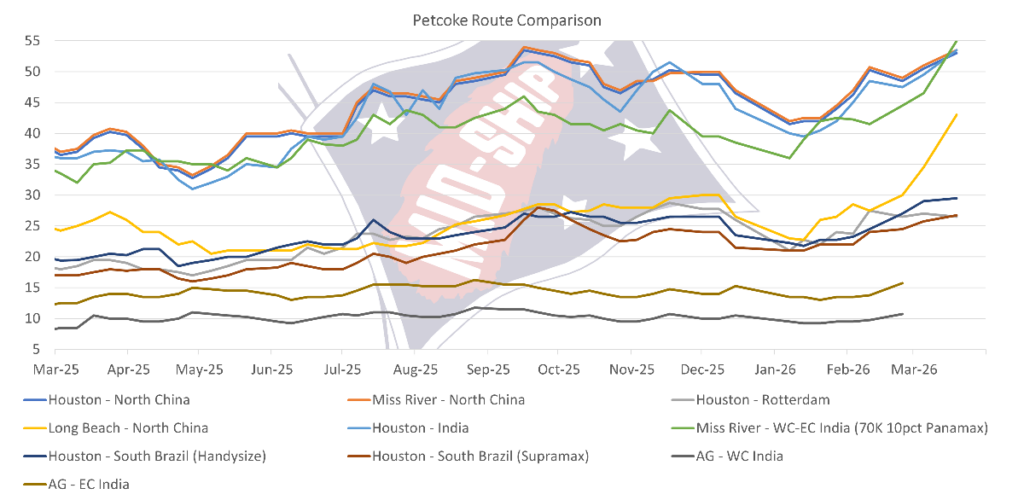

MID-SHIP Report: Dry Bulk Freight Market – February 5, 2026

As we move deeper into Q1, it is becoming clear that 2026 is not shaping up to be the smooth freight market correction many expected. Fleet growth is real and visible, but geopolitical risk, trade-route disruption, and shifting commodity flows continue to absorb effective capacity and support freight levels. The key theme remains: distance over volume. While overall seaborne dry bulk trade growth is moderating, tonne-mile demand continues to outpace cargo volumes. Longer sailing routes, particularly continued diversions away from the Red Sea and strengthening South Atlantic-to-Asia trades, are driving higher vessel demand. At the same time, fuel prices have firmed, and macroeconomic signals remain mixed, reinforcing uncertainty that continues to underpin freight pricing.

Market conditions – stabilising after seasonal softness: After the typical easing seen in very late Q4 and early January, dry bulk markets have begun to stabilise. Capesize earnings appear to have found a floor as longer-haul iron ore and bauxite shipments from the Atlantic improve. Although Chinese iron ore port inventories remain elevated following heavy imports late last year, expectations around post-Lunar New Year restocking, steady infrastructure-related steel demand, and continued long-distance supply flows are supporting near-term sentiment. Panamax and Ultramax markets remain more balanced but are benefiting from solid grain and minor bulk programs, particularly out of South America and Southeast Asia. Handysize markets continue to show regional tightness, with uneven vessel availability in both the Atlantic and Asia helping sustain rates despite ongoing fleet deliveries. While spot markets are not surging, their resilience to downside pressure remains a notable feature.

Supply growth vs. effective availability: Vessel deliveries are accelerating in 2026, led by the Panamax and Supramax segments. However, effective capacity growth is being tempered by longer voyage distances, slightly slower operating speeds, planned dry-dockings, and persistent congestion tied to seasonal grain flows and port inefficiencies. Recycling activity is expected to rise modestly but remains insufficient to meaningfully offset fleet growth. The result is a market that remains finely balanced rather than oversupplied. Cargo outlook… mix and routing matter. Cargo mix continues to matter more than headline volume growth. Iron ore shipments are expanding only marginally, but lower prices and increased exporter competition are encouraging longer-haul flows that disproportionately benefit vessel demand. Coal volumes continue to trend lower overall, with declines in China and developed economies only partly offset by growth in India and Southeast Asia. Grain demand is a clear bright spot early in 2026, with strong South American export programs, additional U.S. soybean volumes flowing into Asia, and steady regional demand supporting Panamax and Ultramax utilisation. In minor bulks, energy-transition commodities, including bauxite and other ores, continue to support tonne-mile demand despite moderating growth rates.

Looking ahead: As we approach the spring cargo season, the dry bulk market appears positioned for continued firmness rather than a sharp correction. Fleet growth is real, but longer distances, uneven vessel availability, and ongoing geopolitical uncertainty continue to limit flexibility.

Bottom line for cargo interests: Early engagement, clear program visibility, and flexibility across vessel classes remain the most effective tools for managing freight exposure in a complex and finely balanced market. Our team is ready to support your strategy and secure competitive freight solutions.


Subscribe below to receive the full report.

MID-SHIP Fertilizer – January 29, 2026

January 29, 2026

Market Overview:

For the Handysize market, extending the upward momentum from the previous session, the market maintained a firm footing, supported by broadly positive sentiment across all key loading areas. The BHSI rose to 609, while the 7TC average climbed by $77 to $10,956, underscoring a gradual but consistent improvement in earnings. Trading in the Continent and Mediterranean remained restrained, with limited cargo flow resulting in only modest rate adjustments across specific routes. Meanwhile, both the South Atlantic and U.S. Gulf continued to register fresh inquiry and fixing activity, lending support to slightly firmer rate levels. Across Asia, fixture details were sparse; however, market participants reported charterers bidding above last concluded levels, signalling a strengthening outlook despite the relatively thin volume of business. This firmer sentiment suggests growing confidence among charterers. Reported activity included the Aurora Trader (37,019 DWT, built 2012), which was heard fixed for a voyage from the East Coast of India to Penang at rates in the mid-to-high $8,000s per day basis delivery Dangjin, although additional fixture details were not made available.

Supramax and Ultramax markets showed a mixed performance across basins. In the Atlantic, sentiment remained more constructive, led by firmer rates on East Coast South America exports and continued momentum in the U.S. Gulf, where increased inquiry translated into several reported fixtures. By contrast, activity in the Continent and Mediterranean was subdued, with limited fresh cargoes allowing rates to ease in thin trading. Pacific trading was split geographically: the northern basin continued to find support from NoPac rounds and trans Atlantic business, while the southern Pacific remained quiet with minimal new inquiry. Period interest added a degree of stability, highlighted by a reported newbuilding Ultramax fixing at around $16,000 daily for a 10 – 14 month duration. Handysize conditions also improved modestly, holding onto recent gains as charterers in both basins appeared more willing to pay above last done levels, pointing to slowly improving sentiment.

The Panamax sector carried a generally positive tone following yesterday’s stronger fixing activity. Fresh grain and mineral cargoes emerged in the Atlantic for mid February positions, including trips out and backhaul business, keeping expectations supported amid tightening tonnage lists. A notable Atlantic fixture saw the 2019 built Bulk Geneva reportedly fixed from the U.S. Gulf to Egypt at $21,000 daily. In the Pacific, however, momentum was steadier rather than sharply firming, with activity slower to surface and the earlier Capesize rally losing steam. While overall rates continued to edge higher, gains were more measured. Capesize rates in ECSA softened slightly on Brazil and West Africa runs to China, with the Tubarão/Qingdao route assessed around $24.00 per tonne, while in the Pacific, steady demand from major miners helped West Australia/Qingdao rates hold near $9.00 per tonne amid firming North Atlantic conditions driven by tight supply.


Subscribe below to receive the full report.

MID-SHIP Cement Report – January 20, 2026

January 20, 2026

Market Overview: 

The dry bulk markets showed a firmer tone midweek, led by notable gains across the Supramax/Ultramax and Panamax segments. Supramax/Ultramax rates moved upward, supported by improved sentiment in both the Atlantic and Pacific. While the South Atlantic remained steady on abundant tonnage, Mediterranean activity strengthened, helped by accumulating cement cargoes. Period interest was also visible, with 6 – 8 months fixed from Xiamen at $15,500 daily. Handysize markets held steady-to-improving, with firmer U.S. Gulf sentiment and further gains in ECSA, despite lighter Pacific activity. The Baltic indices reflected the general uptick, with the Supramax Index at 996 and Handysize at 594. Notable fixtures included the Izumo Hermes at $20,250 daily from Recalada to Nigeria and Cargill fixing the Nordsun at $19,000 daily from North Brazil to the Mediterranean.

Panamax and Capesize markets continued to advance, with fresh inquiry and tightening tonnage driving improved numbers across both basins. The Panamax index rose to 1606, supported by stronger Atlantic fundamentals and a series of fixtures — Harvest Frost securing $27,000 daily from Algeciras for a U.S. East Coast–India run, and Oldendorff fixing the Troodos Oak at $25,000 daily from Ijmuiden for U.S. East Coast/Gulf options to India. Capesizes also held firm, with Brazil/West Africa to China rates climbing to the $21.80 – $22.00 PMT range and Pacific C5 levels in the $8.55 – $8.65 PMT band, pushing the Baltic Capesize Index up to 2732. In the Atlantic, Classic Maritime was linked to the Philippos A for a Tubarao–China run at around $22.00 PMT, underscoring continued strength in the larger vessel classes.


Subscribe below to receive the full report.