MID-SHIP Report: Dry Bulk Freight Market – January 14, 2026

January 14, 2026

Welcome to 2026!!

While we have a new number to put into all our emails, the start of 2026 feels a lot like early 2025 when it comes to government actions and macroeconomic policies raising a palpable level of uncertainty in the freight market. Last year’s wave of trade-related initiatives, rolled out by the United States (answered to varying degrees by other nations), continued pressure on trade via the Red Sea, and USTR implementation created inefficiencies in a market that should have been in decline, but resulted in a solid market appreciation for many market segments during the year. This year’s start, with the backdrop of action in Venezuela (and the impact on continued sanctions), upheaval in Iran and fresh comments on broader trade policy shifts including a 25% U.S. tariff on countries trading with Iran and further tariff action against China, may again cause disruption to what many had expected would be a quieter year, with a continued slow downward correction. Fuel markets are also on edge and oil prices have rallied. Further action in the Mideast/Iran could have dramatic effects on forward pricing, which had been relatively level to this point.

Over the past 2 months, we have seen the market ease in all primary segments and as thinning demand and new vessel arrivals created a soft landing for 2025. Cape pricing for front-haul, using the Baltic Capesize Index 5TC as a benchmark, fell from about USD 27,600/day to USD 23,000/day over this period. The general index for Handy-sized ships likewise softened, with the Baltic Handysize Index declining from roughly 820 points in early November 2025 to about 600 points in mid-January 2026, though there have been pockets of strength in the Atlantic and in SE Asia – the latter influenced by higher steel exports from China (and resulting congestion) to end the year.

It is still too early to say what direction we will see the broader market take this year. The Cape and Panamax segments have eased over the past few weeks, but there is a sight of stabilization/correction in the coming months – a lot will balance on whether China looks to rebuild iron ore stocks after the Lunar holidays next month. The Handy and Ultramax segments continue to see tight supply in certain markets, buoying pricing for the time being. If painted with a broad stroke, given the high level of fleet replacement we have had and will continue into this year, coupled with relatively flat demand indicators, we should be seeing a continuing easing in the general market. However, the “outside” elements of military action, social unrest, and trade policy still have the ability to affect that expectation over the coming months.


Subscribe below to receive the full report.

MID-SHIP Alumina/Bauxite – January 13, 2026

January 13, 2026

Market Overview: 

The dry bulk market saw another muted week, with sentiment soft across all segments.

Handysize: The BHSI fell 6 points to 593, and the 7TC average slipped to $10,675. The Continent and Mediterranean remained positional, with rates below prior levels; Captain D fixed Barcelona – Constanza at $9,000. South Atlantic fundamentals stabilized, while U.S. Gulf activity was minimal amid oversupply, with Ultra Tatio fixed SW Pass – NCSA at $14,500 and a Clipper-owned handy Houston – ARAG at $15,000. Asia stayed quiet with limited cargo, and period interest included Orient Prestige fixed for 3 – 6 months at 92% of BHSI.

Supramax: The market was slow, with widening gaps between owners and charterers in the Atlantic and abundant prompt tonnage in Asia keeping rates flat. The 11TC average closed down $96 at $12,038.

Panamax: Atlantic activity improved slightly, but oversupply kept sentiment weak; Asia was steady, but rates softened. W-Star fixed 9/13 months worldwide at $13,250. The P5TC average fell $80 to $11,978.

Capesize: Rates continued to decline, with the 5TC at $22,180 and C5 at $7.50, reflecting persistent bearish sentiment.

The US has launched an industrial tactic to save its last domestic alumina refinery while building out critical gallium capacity, conclusively deemed a dual move with strategic importance of both feedstock and advanced materials for defence, aerospace and high-tech sectors. Washington has committed USD 450 million in public and private funding to revive the Atlantic Alumina Company’s (ATALCO’s) Gramercy, Louisiana facility, securing alumina production and adding what could become America’s first large-scale gallium production circuit.


Subscribe below to receive the full report.


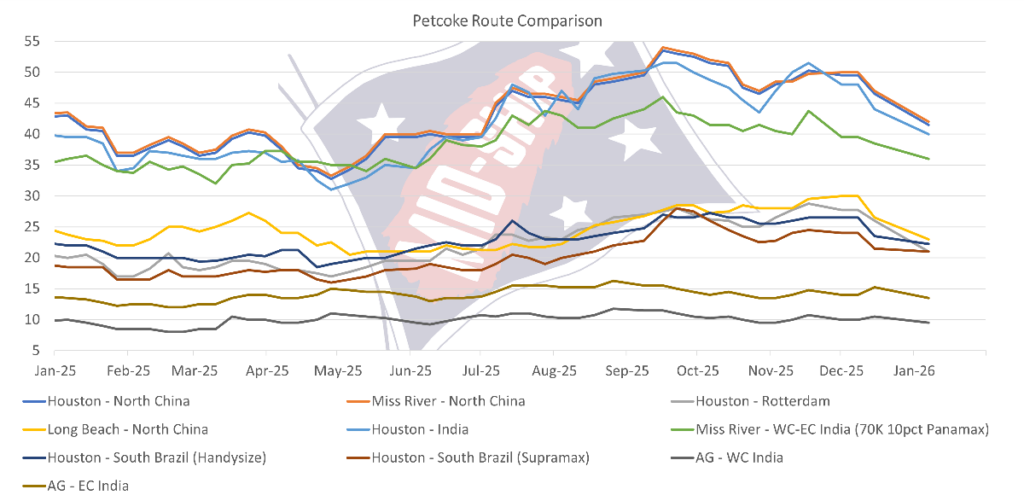
MID-SHIP Petcoke Report – January 7, 2026

January 7, 2026

Market overview:  

Handysize rates softened further, with the BHSI at 624 and 7TC averaging $11,229/day. Activity in the Continent, Med, and U.S. Gulf remains muted amid abundant spot/prompt ships, while South Atlantic fixtures held near $16,000/day for trips to Europe and Morocco. Asian sentiment stays weak despite some fresh demand. Supramax values continued to slide, with the 11TC average at $12,549/day. Limited Atlantic inquiry and oversupply weigh on rates, while Asia sees modest support from coal runs. Panamax shows relative resilience, supported by fronthaul demand and period interest. P5TC rose to $11,851/day, with short-period fixtures reported at $14,250–$15,250/day and NoPac rounds in the low $12,000s. Capesize weakened further, with the 5TC down to $26,098/day amid lengthening tonnage lists.


Subscribe below to receive the full report.
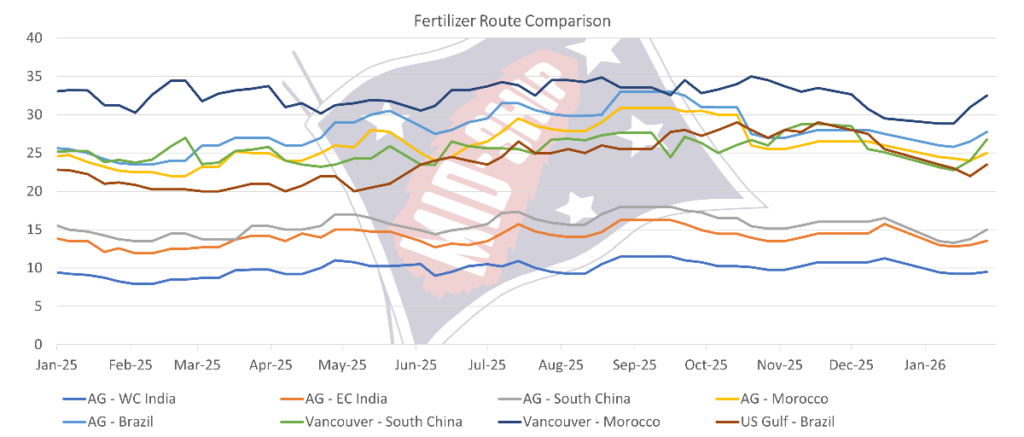

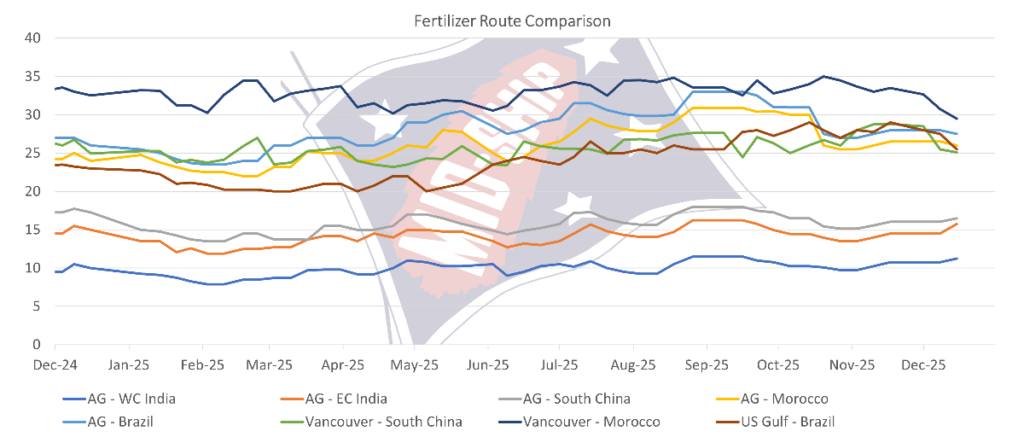
MID-SHIP Fertilizer – December 15, 2025

December 15, 2025

Market Overview:

We ended the prior week for Capes (180,000 DWT) on Friday, December 5, at $42,151, up from $37,158 the week before. Last Monday, we stood at $41,571 (up from $37,840 the previous Monday), then decreased to $35,527 mid-week, and finished at an even lower rate of $30,731 on December 12. The Time Charter Average begins this week at $30,841. The FFA curve on Monday shows December at $34,375 (up slightly from $34,339 for December a week earlier) and January at $21,293 (down slightly from January a week prior $21,321). Q4 is now at $29,184 (up slightly from $29,172 last week). The benchmark Brazil-to-China voyage decreased since last Monday and opened this week at $22.15.

The Panamax market saw a decrease over last week, with daily averages ranging between $16,313 and $15,194. The Trans-Atlantic round is currently assessed at $17,418 (down slightly from $17,577 one week ago), and the Pacific round for a Baltic type is at $12,908 (down from $16,211 one week ago). On Friday, December 5, the time-charter average traded at $16,530. To start this week, the spot average on Monday is $14,796 per day. Forward levels indicate $15,368 for December and $12,461 for January. Q4 is estimated at $16,191, and Q1 2026 is assessed at $12,858 daily.

The Supramax market traded within a narrow range last week. We started last week’s physical market with the Supra 63 time charter average at $18,075. The segment decreased slightly to $17,760 at mid-week and ended the week at $17,333. We begin this week at $17,189. The U.S. Gulf-to-Asia benchmark front-haul for the Supra 63 is assessed at $27,989. Forward assessments levels show December at $17,195, January at $13,291, and Q4 at $17,475 (down slightly from $17,600 last week). Q1 2026 is estimated at $13,498.

Handy-size rates decreased over the previous week. The daily average rates moved from $15,113 to $14,482, and we start the new week at a slightly lower rate of $14,329. The U.S. Gulf-to-Europe trip is assessed at $22,504 (down slightly from $22,607 the prior week). Forward averages stand at $14,525 for December and $11,000 for January. The Q4 average assessment indicates $14,990. Then, in Q1 2026, the average estimated value decreased slightly from last week to $11,133.


Subscribe below to receive the full report.


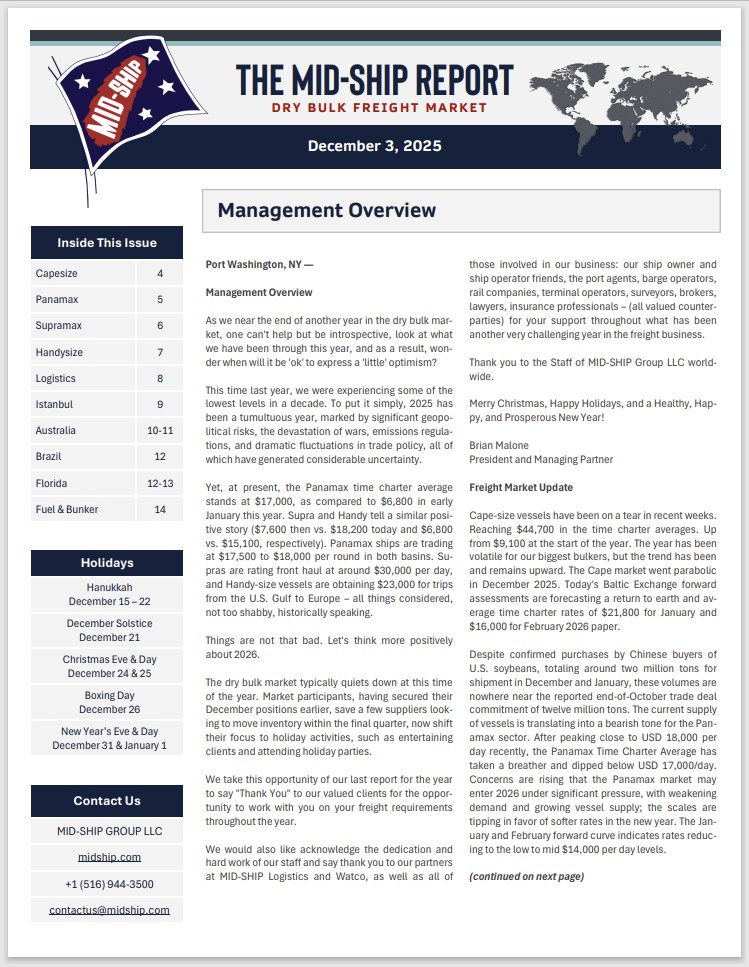
MID-SHIP Report: Dry Bulk Freight Market – December 3, 2025

December 3, 2025

Cape-size vessels have been on a tear in recent weeks. Reaching $44,700 in the time charter averages. Up from $9,100 at the start of the year. The year has been volatile for our biggest bulkers, but the trend has been and remains upward. The Cape market went parabolic in December 2025. Today’s Baltic Exchange forward assessments are forecasting a return to earth and average time charter rates of $21,800 for January and $16,000 for February 2026 paper.

Despite confirmed purchases by Chinese buyers of U.S. soybeans, totaling around two million tons for shipment in December and January, these volumes are nowhere near the reported end-of-October trade deal commitment of twelve million tons. The current supply of vessels is translating into a bearish tone for the Panamax sector. After peaking close to USD 18,000 per day recently, the Panamax Time Charter Average has taken a breather and dipped below USD 17,000/day. Concerns are rising that the Panamax market may enter 2026 under significant pressure, with weakening demand and growing vessel supply; the scales are tipping in favor of softer rates in the new year. The January and February forward curve indicates rates reducing to the low to mid $14,000 per day levels.

The Supramax market began December firm in the U.S. Gulf and South Atlantic due to tight tonnage and steady demand, but rates are expected to soften later as vessel supply improves. In the Pacific, sentiment remains mixed and slightly weak, with selective demand offering limited support amid subdued NoPac activity and ample tonnage.

The Handy-size market remains firm, especially in the U.S. Gulf and the east coast of South America. Sentiment remains balanced in most regions, with sentiment in Northern Europe and the Mediterranean leaning towards the softer side. The market overall maintained positive momentum, as evidenced by the BHSI TC average, which increased to USD 15,127. The Handy-size market on the East Coast of South America is extremely tight for December dates, with a very low vessel count. Although demand is not particularly strong, the lack of tonnage is pushing time-charter levels upward. Market sentiment suggests a softer environment from mid-January onward, driven by weaker demand and a normalization of vessel availability.

Since our previous update two weeks ago, the dry cargo market in Southeast Asia/Far East and Australia has remained relatively stable. Time charter (TC) earnings for Handies have held at similar levels, while Supramax and Ultramax indices have edged upward.

Bunker (VLSFO) prices in Singapore have dropped to USD 444/MT, with the push for peace in Ukraine and the potential for increased Russian supply contributing to lower prices. OPEC has also advised that it will pause any production increases in Q1 2026.

In the domestic market, low water is restricting barge traffic along the inland river system for the 3rd year in a row. At the confluence of the Ohio and Mississippi rivers in Cairo, IL, river levels have dropped 9 feet below the 10-year average, with New Orleans reporting its lowest levels in 10 years as well. The low water and accompanying restrictions are expected to hold through December, with the coming steep drops in temperature expected to compound the delays in all operations. The Upper Mississippi River navigation season has ended. The USDA reported grain barge freight for St. Louis to NOLA was trading at 456.56% of tariff as of the week ending November 25, 2025. For the week ending November 22, barged grain movements totaled 874,250 tons. This was 12% less than the previous week and down 2% from the same period last year.


Subscribe below to receive the full report.

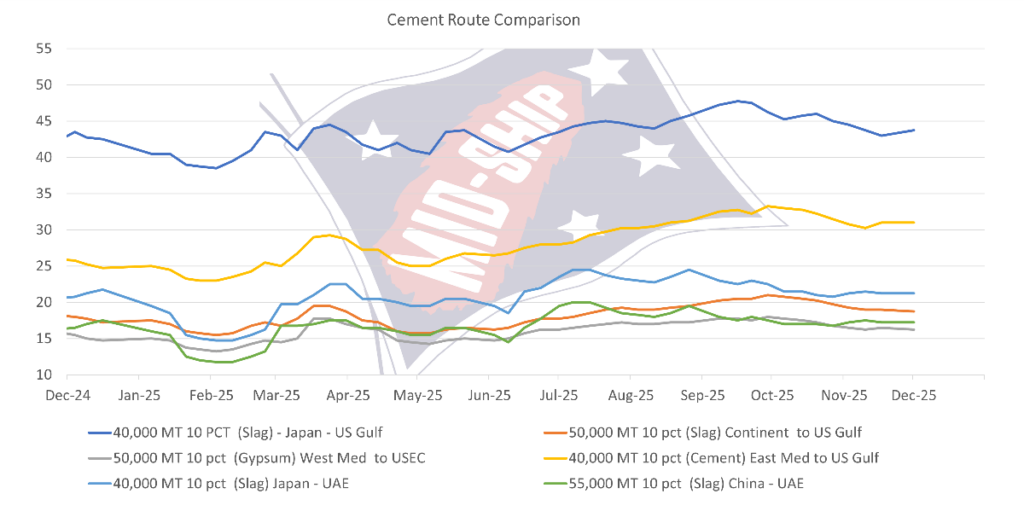
MID-SHIP Cement Report – December 1, 2025

December 1, 2025

Market Overview: 

We ended three weeks ago for Capes (180,000 DWT) on Friday, November 14, at $26,968, down from $27,709 the week prior. Monday, November 17, we stood at $27,597 (up slightly from $27,063 the previous Monday), averaged $30,154 mid-week, and finished at $30,292 on November 21. The Time Charter Average begins this week at $37,840. The FFA curve on Monday shows December at $31,075 (up from December two weeks before $26,368) and January at $22,782 (up from January two weeks prior $20,032). Q4 is now at $28,084 (up from $25,866 two weeks ago). The benchmark Brazil-to-China voyage increased over the past two weeks and opened this week on Monday at $25.28.

The Panamax market saw a slight increase two weeks ago, with daily averages ranging between $16,986 and $17,354. The Trans-Atlantic round is currently assessed at $18,241 (up from $16,873 two weeks ago), and the Pacific round for a Baltic type is at $18,172 (up from $17,643 two weeks ago). On Friday, November 14, the time-charter average traded at $17,071. To start this week, the spot average on Monday is $17,405 per day. Forward levels indicate $17,082 for December and $15,132 for January. Q4 is estimated at $16,762, and Q1 2026 is assessed at $15,049 daily.

The Supramax market traded within a narrow range two weeks prior. On November 17, we started the week’s physical market with the Supra 63 time charter average at $17,989. The segment moved increased slightly to $18,080 at mid-week and ended the week at $18,098. We begin this week at $18,228. The U.S. Gulf-to-Asia benchmark front-haul for the Supra 63 is assessed at $29,143. Forward levels show December at $17,845, January at $15,513, and Q4 at $17,691 (up slightly from $17,658 two weeks prior). Q1 2026 is estimated at $15,204.

Handy-size rates have been steadily increasing over the past two weeks. The daily average rates moved from $14,776 to $14,760, and we start the new week at a slightly higher rate of $14,932. The U.S. Gulf-to-Europe trip is assessed at $21,714 (up from $20,593 two weeks ago). Forward averages stand at $14,720 for December and $12,800 for January. The Q4 average assessment indicates $15,055. Then, in Q1 2026, the average estimated value increased to $12,157.


Subscribe below to receive the full report.


MID-SHIP Report: Dry Bulk Freight Market – November 19, 2025

November 19, 2025

The Cape market remains resilient, with C3 ore fixtures in the mid-to-upper 24s, pushing rates up by about a dollar over the past week on fronthaul Brazil-China runs.

The Panamax sector is showing signs of improvement, with more support emerging in the Atlantic, while the Pacific remains broadly stable. Activity levels have picked up modestly, but charterers continue to resist any significant rate increases.

The Atlantic Supramax market continues an active tone, with sentiment largely positional. In the North Atlantic, rates held steady as fresh tonnage created a more balanced environment. The Pacific market has remained flat, with supply and demand largely in equilibrium.

The Handysize market has delivered a varied performance this week, with regional conditions creating a mixed trading environment. Overall sentiment has held steady, though the tone has softened slightly in areas facing mounting tonnage pressure. The Atlantic began the week on firmer footing, supported by a tighter supply of prompt vessels in the U.S. Gulf and consistent demand heading into late November. Larger Handysize vessels secured transatlantic fixtures at levels noticeably stronger than in previous weeks, signaling a clear recovery from earlier softness. Conditions in the Continent and Mediterranean have held relatively steady. In contrast, the Pacific Basin has experienced a subdued week so far.

Cargo availability remains thin, especially in Southeast Asia, where open tonnage continues to accumulate.

After being under pressure for an extended period, the Middle East and South Asia markets are now starting to see some light, as strong Indo-Coal and South African markets have encouraged fixing levels in the low-mid teens basis ECI for an Indo round. Long-haul routes ex South Africa continue to trade in the $18,000-$20,000 range plus equivalent ballast bonus. Shorter regional trips are underpinning the market in the mid-teens. A Tess 58′ was recently fixed at $14,500 delivery Mumbai for a trip into AG with salt. In general, the market feels to be trading sideways to mildly firmer. Upside requires confirmation of substantial fertilizer liftings, continued firmness in South Africa, and normalization of Red Sea transits. Failure of either leaves the market exposed to an oversupplied short-term outlook.

Since our previous update two weeks ago, the dry cargo market in S.E. Asia/Far East and Australia has remained relatively stable, with time charter (TC) earnings for handies dipping slightly, while supramax and ultramax indices have edged up. Bunker (VLSFO) prices in Singapore have also held steady, pointing to limited volatility in fuel costs in the near term.

However, forward-looking indicators remain cautious. Futures for December and Q1 2026 are still pointing downward, though the much-anticipated “hard stop” in rates in the new year may be less severe than some had forecast. This suggests a moderating market, rather than a cliff-edge collapse, and may provide some relief to charterers and operators alike — assuming no major external shocks.

Switching to inland logistics, low water is restricting barge traffic along the U.S. inland river system for the 3rd grain season in a row. At the confluence of the Ohio and Mississippi rivers in Cairo, IL, river levels have dropped 9 ft below the 10-year average, with New Orleans reporting its lowest levels in 10 years as well. The restrictions that will follow will limit not only the volume to be loaded in barges, but also the number of barges any single towboat may take on a voyage. The low water and accompanying restrictions are expected to hold through November, with river levels forecasted to remain at or slightly below their current levels.

Late October saw a surge in new Chinese soybean orders from the U.S., following the recent trade agreement between the two countries. However, over the last two weeks, it seems trade has stalled, with the bulk of the pledged 12 million tons yet to be moved. Despite the severe shortfall in soybeans this year, U.S. export corn surged to 22.2 million MT, up 77.6% from 2024 (as of September 25).


Subscribe below to receive the full report.


MID-SHIP Petcoke Report – November 17, 2025

November 17, 2025

Market overview:  

We ended the prior week for Capes (180,000 DWT) on Friday, November 7, at $27,709, up from $24,288 the week before. Last Monday, we stood at $27,063 (up from $23,955 the previous Monday), averaged $25,067 mid-week, and finished at $26,968 on November 14. The Time Charter Average begins this week at $27,597. The FFA curve on Monday shows November at $26,786 (up from $25,818 for November a week earlier) and December at $26,368 (up from December a week before $25,411). Q4 is now at $25,866 (up slightly from $25,224 last week). The benchmark Brazil-to-China voyage decreased slightly mid-week, then increased last week and opened this Monday at $23.60.

The Panamax market saw a slight increase last week, with daily averages ranging between $16,601 and $17,071. The Trans-Atlantic round is currently assessed at $16,873 (up slightly from $16,323 one week ago), and the Pacific round for a Baltic type is at $17,643 (up slightly from $17,226 one week ago). On Friday, November 7, the time-charter average traded at $16,501. To start this week, the spot average on Monday is $16,986 per day. Forward levels indicate $16,897 for November and $17,104 for December. Q4 is estimated at $16,746, and Q1 2026 is assessed at $15,103 daily.

The Supramax market traded within a narrow range last week. We started last week’s physical market with the Supra 63 time charter average at $16,777. The segment moved up to $17,255 at mid-week and ended the week at $17,799. We begin this week at $17,989. The U.S. Gulf-to-Asia benchmark front-haul for the Supra 63 is assessed at $31,357. Forward levels show November at $17,570, December at $17,698, and Q4 at $17,658 (up slightly from $17,307 last week). Q1 2026 is estimated at $15,270.

Handy-size rates are increasing slightly from last week. The daily average rates moved from $14,567 to $14,745, and we start the new week at a slightly higher rate of $14,776. The U.S. Gulf-to-Europe trip is assessed at $20,593 (up from $19,246 the prior week). Forward averages stand at $14,594 for November and $14,430 for December. The Q4 average assessment indicates $14,906. Then, in Q1 2026, the average estimated value increased to $11,587.

Cemex’s 5% rise in third-quarter cement volumes offset a weak first half, leaving overall volumes up 1% despite declines in Mexico and the U.S. Growth in EMEA (7%) and SCAC (3%) supported recovery. Nine-month revenue fell 3% to $11.95 billion, and profit dropped 6%, though Q3 revenue and profit rose 5% and 7% on higher prices and lower fuel costs, including reduced petroleum coke expenses. Cemex sold its Panama unit, bought Couch Aggregates, and remains optimistic about U.S. and Mexican demand from infrastructure and the 2026 World Cup, while expecting slight overall volume declines but regional growth and further energy cost reductions.


Subscribe below to receive the full report.


MID-SHIP Cement Report – November 10, 2025

November 10, 2025

Market Overview: 

We ended the prior week for Capes (180,000 DWT) on Friday, October 31, at $24,288, up from $23,811 the week before. The market saw an increase throughout the previous week and ended the week on a positive note. On Monday, we stood at $23,955 (up slightly from $23,534 the previous Monday), averaged $25,573 mid-week, and finished at $27,709 on November 7. The Time Charter Average begins this week at $27,063. The FFA curve on Monday shows November at $25,818 (up from $23,396 for November a week earlier) and December at $25,411 (up from December a week before $24,346). Q4 is now at $25,224 (up from $24,062 last week). The Cape market continues to be driven by iron ore pricing and Chinese import volumes. The benchmark Brazil-to-China voyage increased slightly throughout the week and opened this Monday at $23.30.

The Panamax market saw a decrease last week, with daily averages ranging between $16,207 and $16,501. The Trans-Atlantic round is currently assessed at $16,323 (down slightly from $16,709 one week ago), and the Pacific round for a Baltic type is at $17,226 (up from $16,263 one week ago). On Friday, October 31, the time-charter average traded at $16,389. To start this week, the spot average on Monday is $16,601 per day. Forward levels indicate $16,847 for November and $16,965 for December. Q4 is estimated at $16,683, and Q1 2026 is assessed at $14,647 daily.

The Supramax market traded within a narrow range last week. We started last week’s physical market with the Supra 63 at $16,688. The segment moved down slightly to $16,515 at mid-week, and ended the week at $16,678. We begin this week at $16,777. The U.S. Gulf-to-Asia benchmark front-haul for the Supra 63 is assessed at $28,739. Forward levels show November at $17,016, December at $17,198, and Q4 at $17,307 (up from $16,699 last week). Q1 2026 is estimated at $14,490.

Handy-size rates are dropping slightly from last week. The daily average rates moved from $15,131 to $14,582, and we start the new week at a slightly reduced $14,567. The U.S. Gulf-to-Europe trip is assessed at $19,246 (down from $20,971 the prior week). The spot physical market continued to be positional (regional market specific) and volatile based on cargo size and dates. Forward averages stand at $14,590 for November and $14,340 for December. The Q4 average assessment indicates $14,875. Then, in Q1 2026, the average estimated value increased to $11,383.


Subscribe below to receive the full report.

MID-SHIP Fertilizer – November 3, 2025

November 3, 2025

Market Overview:

We ended the prior week for Capes (180,000 DWT) on Friday, October 24, at $23,811, down from $25,882 the week before. The market faced unstable conditions from Monday through Wednesday before regaining momentum and ending the week on a positive note. On Monday, we stood at $23,534 (down from $25,944 the previous Monday), averaged $23,580 mid-week, and finished at $24,288 on October 31. The Time Charter Average begins this week at $23,955. The FFA curve on Monday shows November at $23,396 (down from $24,400 for October a week earlier) and December at $24,346 (down from November $24,721). Q4 is now at $24,062 (from $24,583 last week), suggesting near-term caution but a constructive outlook toward year-end. The Cape market continues to be driven by iron ore pricing and Chinese import volumes. The benchmark Brazil-to-China voyage was mixed throughout the week and opened at $23.01, with signs of positional strength.

The Panamax market improved last week, with daily averages ranging between $17,292 and $16,962. The Trans-Atlantic round is currently assessed at $16,709 (down from $18,623 one week ago), and the Pacific round for a Baltic type is at $16,263 (down from $17,565 one week ago). On Friday, October 24, the time-charter average traded at $17,318. To start this week, the spot average on Monday is $16,207 per day. Forward levels indicate $16,111 for November and $16,257 for December. Q4 is estimated at $16,647, and Q1 2026 is assessed at $14,104 daily.

The Supramax market traded within a narrow range last week. We started last week’s physical market with the Supra 63 at $17,208. The segment moved down to $16,966 at mid-week, and ended the week at $16,762. We begin this week at $16,688. The U.S. Gulf-to-Asia benchmark front-haul for the Supra 63 is assessed at $26,546. Forward levels show November at $16,227, December at $16,163, and Q4 at $16,699 (up from $16,366 last week). Q1 2026 is estimated at $14,076.

Handy-size rates are dropping slightly from last week. The daily average rates moved from $15,736 to $15,243, and we start the new week at a slightly reduced $15,131. The U.S. Gulf-to-Europe trip is assessed at $20,971 (down from $22,450 the prior week). The spot physical market continued to be positional (regional market specific) and volatile based on cargo size and dates. Forward averages stand at $14,470 for November and $14,220 for December. The Q4 average assessment indicates $14,795. Then, in Q1 2026, the average estimated value increased to $10,968.

A 27K metric tons stem was recently fixed via Brazil to USG, laycan Mid-November was done around USD 37.50 per metric tons. Canpotex is out with their usual NOPAC to Singapore /Japan or ECSA options for TCT. Understand last week Canpotex fixed an Ultramax basis delivery Far East at USD 11K DOP.


Subscribe below to receive the full report.