MID-SHIP Report: Dry Bulk Freight Market – Dec 6, 2024

December 6, 2024

The Baltic Exchange Main Overall Index hit new lows this week, levels not seen since September 2023.

Cape Market continues to struggle with rates the bell weather Brazilian Iron ore flows, all trading at a significant discount this week. Brazil/Europe Cape freight flows are trading now under $10 per metric ton, and front haul movements to China will soon be trading under $18 per metric ton (remember, as of 1-2 months ago, this trade was almost 10 USD more a ton then today’s spot which shows the headwinds the South Atlantic Cape Market has had in the 4th quarter this year).

There are no signs of a recovery in the Panamax market anytime soon. The Time Charter Average is currently trading at half its value compared to December last year, approaching the next support level of $8,000 per day. In the Pacific Basin, despite Beijing’s efforts to sustain the market, freight rates have now leveled off with those in the Atlantic Basin. The market is so depressed that ship owners are willing to compete with the Capesize market to secure employment for their vessels, leading to several Capesize cargoes being split into Panamaxes.

Transatlantic voyages Supramax vessels have been ticking up to around USD 19,000 per day, while front hauls are around USD 20,000 per day. However, many feel that rates may flatten out as the calendar turns to December. The South Atlantic has been facing downward pressure due to a lack of fresh cargoes from East Coast South America. The Continent has not had much activity, while the Mediterranean and the Black Sea have been depressed, with backhaul rates lower than the handy backhaul rates. The market in the Pacific has seen less activity for backhaul cargoes, but there has been more demand for Nopac round voyages.

The past two weeks in the Atlantic market have been active but varied depending on the region. In the US Gulf, the Handysize market remained steady despite a brief increase in activity after the Thanksgiving holiday. In the South Atlantic, the pre-holiday rush created a strong wave of activity, with healthy demand for premium trades to destinations like the West Coast of South America; however, logistical challenges, including weather disruptions in ECSA, led to some delays and renegotiations. In the Far East, steel cargoes are surfacing again in several different directions. However, with a lagging Supramax market, the bigger ships are starting to compete with larger Handies on these backhauls. SE Asia has gained some momentum with coal and wood pellet orders and is looking to source prompt ships.

The South Atlantic shipping markets experienced a volatile week across the Cape, Panamax and Ultra-Supra sizes, with downward trends dominating due to a mix of external factors and bearish market dynamics.

With the UAE celebrating National Day 2024 on Monday and Tuesday, it is no surprise that the Indian Ocean market experienced a notably sluggish start to the week. Festivities and public holidays across the region temporarily reduced commercial activity, leading to a slower pace in the market, which is reflected in the limited availability of cargo entering the market.

When speaking with vessel owners in the Handy, Supra, and Ultra segments in Australia and the surrounding region, we sense a positive atmosphere and some optimism regarding a potential market uptick for the year’s end. However, when looking at the spot Baltic indexes, futures, and oil prices, it appears that the positive sentiment may be more linked to the upcoming holiday season rather than solid market fundamentals.

Regionally, Handy, Supra, and Ultra rates have dropped significantly over the past couple of weeks (see below), and futures prices have also fallen sharply in both segments. Decline in oil prices is also adding downward pressure to freight levels and we are not seeing a noticeable uptick in market orders, making it challenging to share in the optimism.

In the inland barge markets, the USDA reported that grain barge freight from St. Louis to NOLA was trading at 399% of tariff as of November 26, 2024, a 6% increase from the same week last year. Grain barge movements on the Mississippi River for the week ending November 23 were 17% higher than the three-year average for the same week.


Subscribe below to receive the full report.

MID-SHIP Petcoke Report – Dec 4, 2024

December 4, 2024

Market overview: 
Last week, the dry bulk market continued to decline as it closed the week with the Baltic Exchange’s key index dropping to a three-week low as rates declined across the larger sizes. Most significantly, the Cape size market took a hit as it dropped nearly 25% w-o-w, marking its lowest levels since early November. This downturn unfolded amid volatile iron ore futures, which saw fluctuations despite positive trading activity on China’s Dalian Commodity Exchange. This is largely in part due to the market bracing for impact as President-elect Trump has threatened to enforce tariffs more than 60% on all Chinese-exported products.

The Panamax segment extended its downward trajectory, ending the week with its tenth consecutive decline and reaching its lowest levels in over a year. Relative to the Cape size, smaller vessel categories decreased marginally, with both the Supramax and Handysize Indices falling only 1%, remaining relatively stable at the previous month’s levels.

The Supra/Ultramax market in the Pacific experienced a slight uptick especially in the NOPAC prior to Thanksgiving holidays. Optimism persists as adverse weather and ships delaying are expected to tighten availability moving into December. In the Atlantic, rates declined as vessel supply continued to exceed demand, though T/A levels showed a modest w-o-w improvement. Handysize rates in the Pacific remained steady, supported by strong competition for Australian grain shipments and the emergence of forward steel cargoes. Meanwhile, Atlantic rates held firm, reflecting consistent cargo flow throughout the week. In the US Gulf, both Ultramax and Handysize markets saw a flurry of pre-Thanksgiving activity as owners and charterers rushed to secure fixtures. Ultramax T/A and FH routes remained in the high teens, with rate stability anticipated heading into December. The USG Handy market also saw an early-week spike in activity, but rates stayed flat, with over 40 vessels set to open in the USG, NCSA, and USEC over the next three weeks.

Ship recycling activity remains subdued due to several factors, including fluctuating steel prices and unfavorable economic conditions in key recycling markets like South Asia and Turkey. India, historically a dominant player in ship recycling, has faced reduced demand due to declining steel plate prices and currency depreciation. Similarly, Pakistan’s market has been constrained by limited foreign reserves and restrictive financial policies, while Turkey has also seen a slowdown in activity, partly due to lower tonnage availability and economic pressures. Despite these challenges, some stability has recently been observed in steel prices, which may encourage marginal recovery in recycling activity moving forward.


Subscribe below to receive the full report.


MID-SHIP Cement Report – Nov 26, 2024

November 26, 2024

Market Overview: 
Last week, the Cape size market experienced a significant decline in rates, aligning with the broader trend in the dry bulk market, largely due to weak demand in the Panamax segment. The Panamax, Supramax, and Handysize segments continued to trade within a narrow range, with an oversupply of vessels exerting pressure across all segments.

Despite concerns about demand, iron ore production remains strong. Major producers such as BHP, Fortescue, and Rio Tinto have either maintained or increased their production levels. Iron ore prices are expected to be volatile due to slowing growth in steel production and increased output from global producers. According to the International Energy Agency (IEA), global coal demand reached an all-time high this year. Steam coal is expected to decline by low single-digit percentages annually while coking coal looks to be flat through 2026.

The robust market conditions have discouraged the scrapping of older vessels, resulting in an aging fleet. However, high secondhand prices, until recently, have encouraged some owners to invest in new builds. Recently, we have observed a decline in secondhand prices.

Approximately 30% of the Handy fleet, 25% of the Supra/Ultra fleet, and just over 25% of the Panamax fleet are 15 years old or older. About half of these percentage numbers represent ships 20 years or older.


Subscribe below to receive the full report.

MID-SHIP Fertilizer – Nov 20, 2024

November 20, 2024

Market Overview:
Last week, the capesize market showed improvement with robust activity in both basins, while Panamax, Supra, and Handy size segments traded within a narrow range. Panamax ended the week slightly up, whereas Supra and Handy sizes saw modest declines, with long vessel count lists weighing on all segments. Despite low activity levels in most segments, the Baltic Dry Index rose, driven by increases in capesize vessel rates. China’s coal imports surged by 29% year-on-year in October. Brazil’s grain exporters association, Anec, raised its November export estimates for corn, soybeans, and soymeal, although these projections remain below last year’s figures. The EU’s weekly wheat exports totaled 223,323 tons, a 30% decrease in the new marketing year compared to the previous year. Iron ore prices have been volatile as the market anticipates the impact of China’s recently announced economic stimulus on economic growth, amid concerns of increased iron ore supply, healthy inventory levels, and a slowdown in steelmaking at Chinese mills.


Subscribe below to receive the full report.


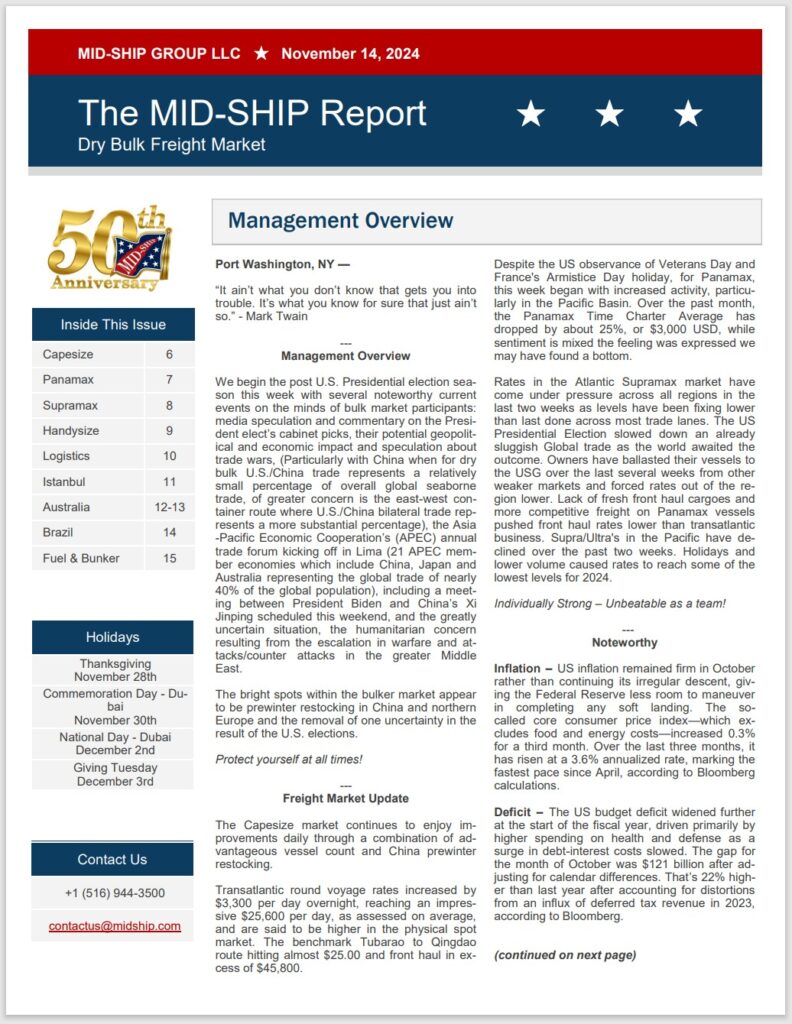
MID-SHIP Report: Dry Bulk Freight Market – Nov 14, 2024

November 14, 2024

The Capesize market continues to enjoy improvements daily through a combination of advantageous vessel count and China prewinter restocking.

Transatlantic round voyage rates increased by $3,300 per day overnight, reaching an impressive $25,600 per day, as assessed on average, and are said to be higher in the physical spot market. The benchmark Tubarao to Qingdao route hitting almost $25.00 and front haul in excess of $45,800.

Despite the US observance of Veterans Day and France’s Armistice Day holiday, for Panamax, this week began with increased activity, particularly in the Pacific Basin. Over the past month, the Panamax Time Charter Average has dropped by about 25%, or $3,000 USD, while sentiment is mixed the feeling was expressed we may have found a bottom.

Rates in the Atlantic Supramax market have come under pressure across all regions in the last two weeks as levels have been fixing lower than last done across most trade lanes. The US Presidential Election slowed down an already sluggish Global trade as the world awaited the outcome. Owners have ballasted their vessels to the USG over the last several weeks from other weaker markets and forced rates out of the region lower. Lack of fresh front haul cargoes and more competitive freight on Panamax vessels pushed front haul rates lower than transatlantic business. Supra/Ultra’s in the Pacific have declined over the past two weeks. Holidays and lower volume caused rates to reach some of the lowest levels for 2024.


Subscribe below to receive the full report.

MID-SHIP Alumina/Bauxite – Nov 12, 2024

November 12, 2024

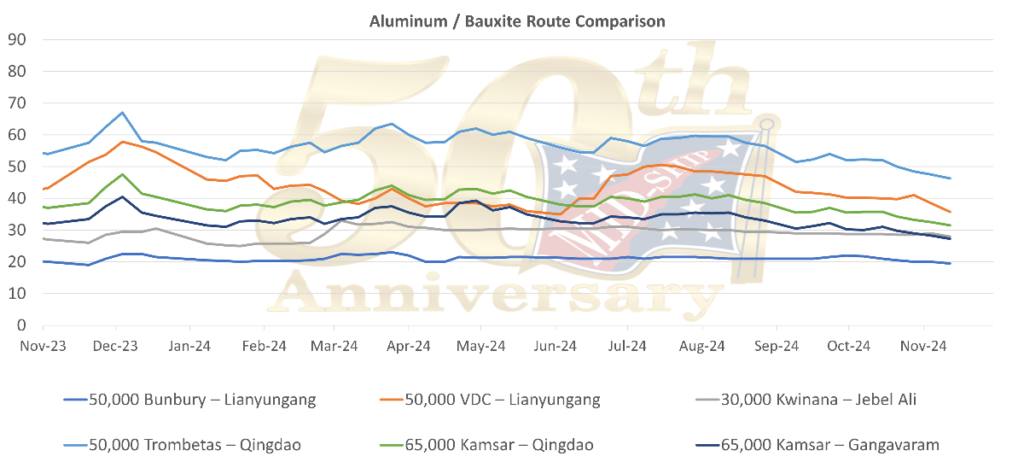
Market Overview: 

Following the U.S. Presidential election, the freight market remains stable. The cape-size sector stands out as a positive exception. Market participants are managing daily challenges within a balanced supply-demand ratio and higher spot vessel counts, while considering potential shifts in U.S. geopolitics, economic policies, and trade tariffs in the upcoming year.

It is worth noting China’s tariffs on U.S. soybeans and corn, imposed in 2018, remain in effect. Additionally, the current U.S. administration significantly increased existing US tariffs on imported Chinese goods, including semiconductors, EV’s, Ship to Shore Cranes and steel and aluminum, in May of this year.

Water levels in the Mississippi and Amazon rivers present challenges for grain and mineral exporters, respectively. The seasonal stocking of coal and ore ahead of China’s winter is reflected in the October import numbers and the increased cape size rates, a trend likely to continue into the first weeks of November.


Subscribe below to receive the full report.


MID-SHIP Petcoke Report – Nov 5, 2024

November 5, 2024

Market overview: 
The market continues to be neutral and unexciting in what should be a time of upward momentum seasonally. China economics, US Presidential elections and water levels in both Amazon and the Mississippi are uncertainties market participants are grappling with. India continues to vie for position to displace China as the prime mover in the dry bulk freight markets. India celebrated the Hindu festival of lights “Diwali” at the end of last week, taking a big player off of the board for several days at an already quiet time in the marketplace.

After ending the prior week at $15,395, down from $18,875 a week earlier in the cape market, the Cape-size market traded down throughout the week’s end. Last Monday, we were at $14,811, moving the average down to $15,311 at mid-week and ending at $15,329 by Friday. The Time Charter Average currently sits at a softer $15,332 as compared to $14,811 one week ago. Today’s FFA forward curve points to November contract at an improved $18,664 when compared to today’s spot number, an increase in December at $21,504. The three-month Q4 contract is assessed at $20,357. The benchmark Brazil to China voyage was basically flat at $20.38, well down from $24.79 three weeks ago. Q4 2025 paper is marked at a firmer $24,071 up from $23,921 a week ago.


Subscribe below to receive the full report.

MID-SHIP Report: Dry Bulk Freight Market – Oct 31, 2024

October 31, 2024

Cape-size rates have been under pressure this week as sentiment in China weighs heavily on the segment. Both oil and iron prices are also under pressure. Rates are down substantially across all benchmark routes. The front haul dropping from about $44,000 to $35,000 per day, and the long round China to Brazil and back falling from $20,000 to $14,000 per day in the past two weeks. Despite recent reports of China’s economic struggles both iron ore and coal import volumes have been strong in year-over-year terms.

The Panamax market continues to face challenges on the spot market while ship owners maintain their positions in the long-term period sector. Despite being in the fourth quarter, which is historically one of the strongest periods of the year, there are no signs of recovery. The Panamax Time Charter Average has dropped another 15% in the last two weeks and is now trading at 50% of its value since the March 2024 peak, a trend that is difficult for most ship owners to endure.

The Supramax market has shown relative stability across most regions over the past week, with only minor rate fluctuations despite ongoing shifts in commodity demands, geopolitical headlines, the looming US elections, and seasonal changes. In the Atlantic, rates have been supported by grain exports as the US harvest season kicks in.

In Asia, the market performance is mixed. Forward Freight Agreements (FFAs) and short-period rates are positive and expected to rise by year-end.

At the risk of sounding like a broken record, trading in the Handysizes continues to be range-bound. Daily rates moved from $13,073 to $13,098 last week (as compared to a range of $12,941 to $13,078 a week ago), and today, we stand at $12,967. The physical market rate for a trip from the U.S. Gulf to Europe is about $15,471 – up from $14,893 last week. The forward curve shows Q4 paper assessed at $12,556, and Q1 25 at $9,912 (down from $10,433 last week). Q2 2025 is at $11,950 and Q4 2025 at $11,850.

The South Atlantic freight market continues its unseasonal pessimism. We fear the historical drought experienced in Brazil will negatively affect Agri exports in the upcoming season. Inflation is currently said to be at 4.5%, but some Brazilian economists speculate that the percentage of inflation will soar in the coming months.

The news in inland logistics in North America is low water on the Lower Mississippi River has cut river drafts to 9’0″, which considerably reduces barge capacity by 400-500 tons. Southbound grain freight rates have spiked up to 900% of the tariff, up from 725% the prior week. In the same period last year, they were at 575% of the tariff. This constraint comes at a time when the grain harvest is reaching its peak, and crop yield is projected to be one of the largest crops on record for soybeans and the second largest for corn. Even in good operating conditions, this high volume and peak harvest could overwhelm the barge market.


Subscribe below to receive the full report.


MID-SHIP Cement Report – Oct 29, 2024

October 29, 2024

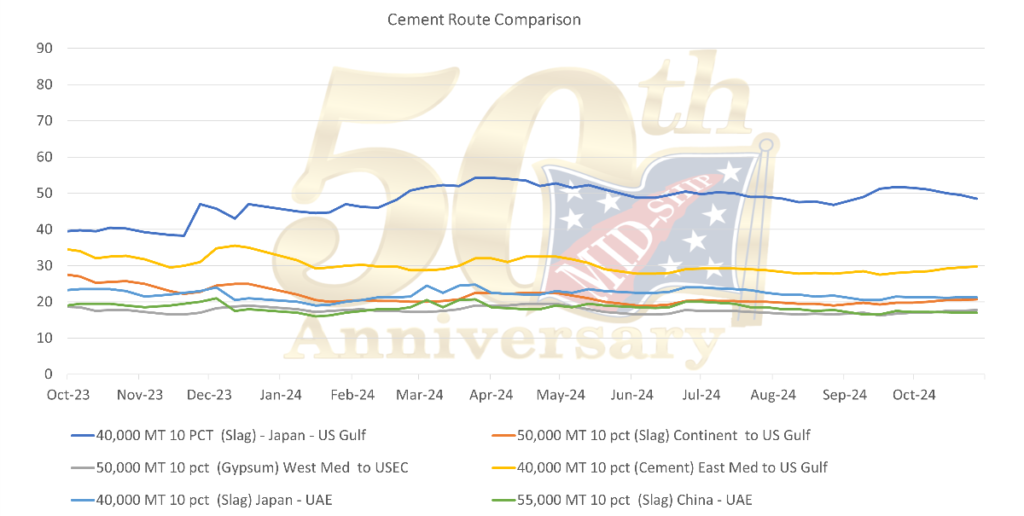
Market Overview: 
The market continues slowly for this time of year. All eyes are on China as troubling signs continue to be registered across commodity markets. The CEO of Brazil’s Suzano, controlling one-third of the global hardwood pulp supplies, recently described “ the most challenging scenario ever” in top importer China, adding there are signs of stabilization, citing stabilizing prices and resilient demand levels after further erosion in the third quarter. The nearing conclusion of a close US Presidential election impacts our markets as market participants weigh the possible outcome and the implications of potential tariffs. iron ore prices have been trending lower compared to last month and last year. The spot price for iron ore is currently at $92.83, down from $99.91 last month and $120.98 a year ago. Despite these factors, the demand for coal remains robust. Thermal power generation in China increased by nearly 10% year-over-year in September, and coal imports rose by 13% to a record high of 47.6 million tons.


Subscribe below to receive the full report.

MID-SHIP Fertilizer – Oct 21, 2024

October 21, 2024

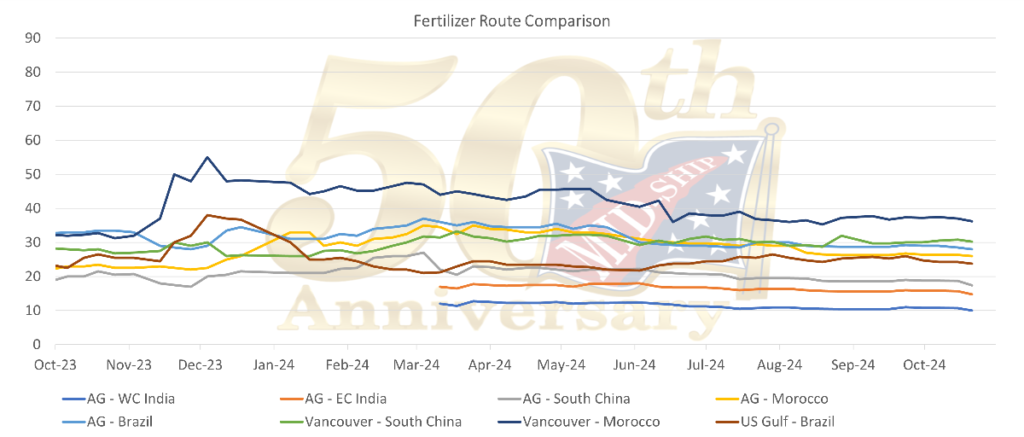
Market Overview:
Hope springs eternal for a so far unrealized seasonal improvement in dry bulk rates. Capes and Panamax have had an uninspiring week. Supra and Handy size have seen pockets of improved rates and a fair bit of positional volatility. Period activity at firm levels and moderate improvements across the forward assessments for Forward Freight Agreement contracts allow market participants to hope for improvement in the coming weeks. We remain cautiously optimistic due to stable demand and supportive supply-side fundamentals.


Subscribe below to receive the full report.