MID-SHIP Petcoke Report – June 18, 2025

June 18, 2025

Market overview:  

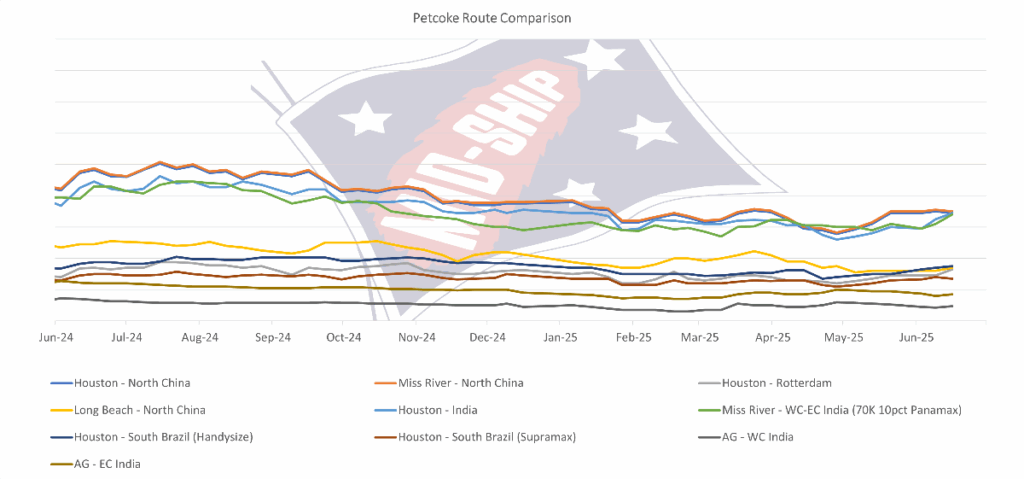
The past week was positive, albeit trading within a narrow range for all sizes except Cape size, which continues to outperform — the Cape size Time Charter average moved from $24,900 to about $30,950 per day. The Cape size market has been up substantially over the past two weeks. The fortunes of the two Panamax trading basins have reversed their springtime trend, with the Atlantic round now priced higher at $12,755, and in the Pacific, a round voyage for a Baltic type is assessed at $11,450. The Supramax market was mixed last week, trading along a narrow range. In the Handy market, the trip from the U.S. Gulf to Europe has improved to about $15,000, up from $13,929 a week ago and $12,743 two weeks ago.

Last week, the U.S. Trade Representative announced proposals and called for public comment, which included an intention to reduce U.S. port fees for foreign-built car carriers and change the regulatory framework impacting LNG carriers. Stakeholders have until July 7, 2025, to submit comments.

At the start of the week, China and the U.S. agreed to maintain (read ‘reestablish’) bilateral tariffs at the levels set in their initial/prior mid-May meeting.

The past week ended, and the new week began with a significant development in the Middle East with Israel’s initial attack and ongoing operations against Iran’s military defenses, nuclear infrastructure, and installations, and Iran’s retaliation. Oil prices surged after the initial attack and have since receded. The stock market on June 16 didn’t seem to mind. War risk premiums are up, and vessel owners refuse to trade in the area/Persian Gulf.

Reports indicate China’s coal and iron ore imports again declined month over month in May, while Chinese soybean imports hit a new record high.

This is just a reminder of EU ETS, the European Union’s cap-and-trade system designed to reduce greenhouse gas emissions by setting a limit on total emissions and allowing the trading of emission allowances. Companies operating within the European Union Emissions Trading System (EU ETS) must surrender, by September 30, 2025, the required EU Allowances (EUAs) to cover their verified emissions from the previous year. For Maritime Transport, this means the 2024 emissions. This deadline allows EUAs to be surrendered in installments between March 31 and September 30, provided the required amount is met by the final date. Failure to comply with this deadline can result in penalties and restrictions on future EUA transactions.


Subscribe below to receive the full report.


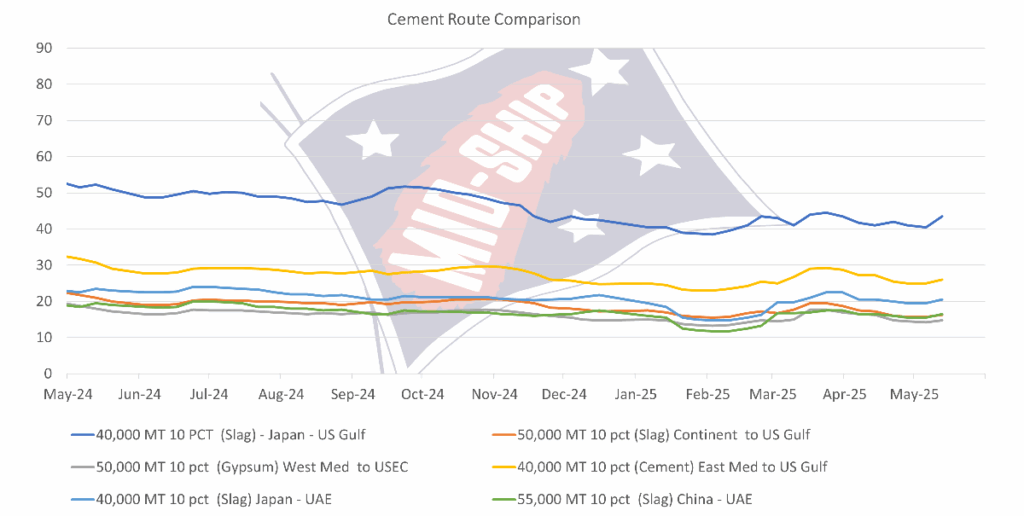
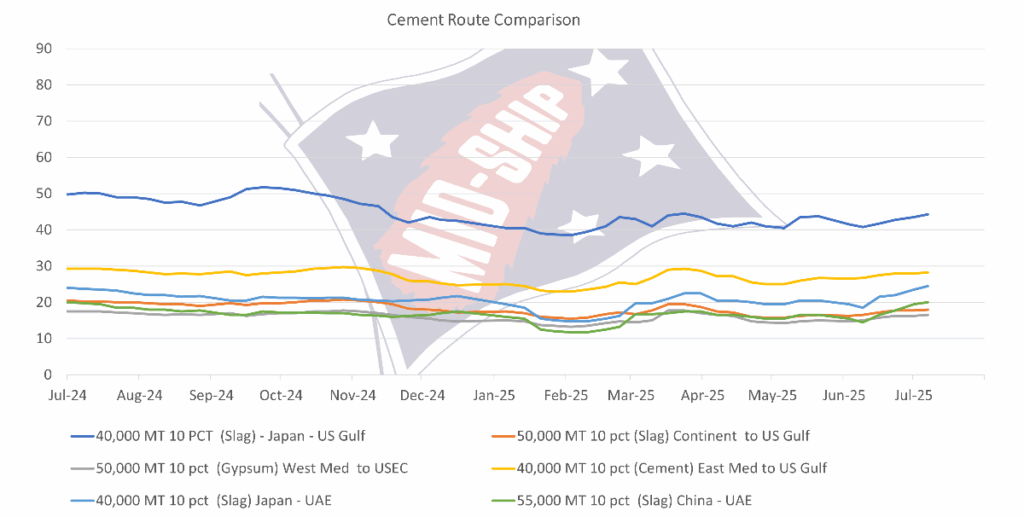
MID-SHIP Cement Report – June 12, 2025

June 12, 2025

Market Overview: 

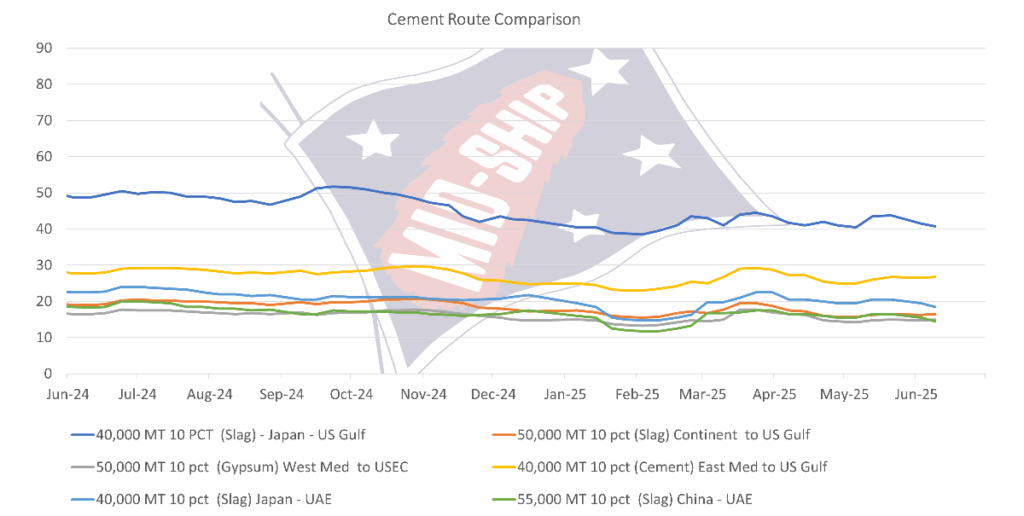
The dry bulk market this week is characterized by stable Cape size rates driven by iron ore demand, improved Panamax rates (albeit at low levels historically speaking), Supra’s unexciting, while spot rates for Handy size bulkers sailing from the U.S. Gulf Coast surged to a near seven-month high and broader challenges from positional oversupply and geopolitical trade tensions. Recovery signs are tempered by seasonal and economic headwinds, particularly in China.

In the past week Cape rates improved daily from $18,800 to $24,900 daily. Panamax was mixed and now up slightly. Supra’s down within a narrow range. Handy size held steady overall, trading in a range between $10,750 and $10,813 on the daily time charter average.

The ongoing negotiation and introduction of U.S. tariffs, reciprocal tariffs, and USTR fees and retaliatory actions, including China, continue to create a high level of uncertainty in our market as we navigate the more seasonal summer market in the northern hemisphere.

Steel production in China remains tepid, pressuring rebar prices to a five-year low.

Thermal coal prices recently hit a four-year low, as increased output from major producers has depressed prices, and this oversupply continues to weigh on the seaborne coal market, particularly Panamax in the Pacific. China has urged coal-fired power plants to prioritize domestic coal use. Argus Media reported recently that India’s coal imports (including thermal and coking coal) dropped by 9.2% from April 2024 to February 2025, totaling 220.3 million metric tons. This decline was driven by increased domestic coal production.

U.S.-China trade talks in London on June 9, 2025, aimed at easing trade disputes, could indirectly stabilize commodity demand, including iron ore, but no immediate market impact is reported as of the time of writing.

The OECD forecasts global economic growth to slow to 2.9% in 2025, down from 3.3% in 2024. This is a revision from their earlier projection of 3.1% for 2025, as noted in the OECD Economic Outlook, Volume 2025 Issue 1, published on June 2, 2025. The downgrade is attributed to rising trade barriers, heightened policy uncertainty, tighter financial conditions, and weakening consumer and business confidence, particularly due to U.S. tariffs and global trade tensions.


Subscribe below to receive the full report.


MID-SHIP Report: Dry Bulk Freight Market – June 5 2025

June 5, 2025

Fundamentally, the market remains consistent with early 2025 conditions, characterized by a mature commodity cycle and potentially reduced volumes of both major and minor bulks, uncertainty due to geopolitical risk (Russia-Ukraine, Gaza, India-Pakistan), and the U.S. government’s global trade negotiations. The vessel fleet continues to grow moderately.

The largest vessels are enjoying a favorable supply-demand balance in 2025. The Cape size fleet growth is projected to be minimal this year, while ton-mile demand growth is expected to be above 3%. The Baltic Dry Index (BDI) and Cape size-specific indices are expected to remain volatile, with stronger performance in Q3 due to seasonal commodity demand but potential softening in Q4 if economic headwinds intensify. Projects like Guinea’s Simandou and West Australia’s Onslow enhance long-haul trade prospects. The benchmark route from Brazil to China is reported at over $24.00 per ton and heading north, as compared to $18.20 this time last month.

The Panamax market has been under pressure during the month of May, declining from $12,400 to $10,000 on average in the month. Fortunately, at least now, perhaps on a tailwind from the firm Cape market, but more likely strong demand for grain shipments originating in the Atlantic, both trans-Atlantic and Front Haul, and a pick-up in USEC to India Coal trades. China’s slowing demand has been driving Panamax rates in the Pacific down by 50% since April when prospects within the basin were significantly brighter. Now, Panamax is at parity in both basins.

The Supramax/Ultramax segment of the market has entered a more subdued phase after a previously bullish stretch. The U.S. Gulf, which had been a bright spot with Trans-Atlantic and petcoke runs commanding robust returns, is now showing signs of cooling. A growing number of open ships and a narrowing spread of viable cargoes are beginning to weigh on rates. Early June optimism has given way to a more measured outlook, with forward sentiment pointing to a softer second half of the month. A widening gap between vessel supply and cargo demand is becoming increasingly apparent in the Asia-Pacific region. While North Pacific rounds have held steady, Southeast Asia continues to lag behind expectations. Indonesian coal exports remain subdued as China’s push to stockpile more domestic coal while curbing imports has affected demand and added pressure to rates.

Since our previous report, the Handy size dry bulk market has remained subdued across both the Atlantic and Pacific basins, with limited fresh inquiries and an oversupply of prompt tonnage. While select submarkets have experienced modest gains, overall activity has been restrained. The positive momentum highlighted two weeks ago has persisted, with the U.S. Gulf maintaining its strength. The South Atlantic market has remained steady to firm, underpinned by balanced supply and demand dynamics. Activity in the Continent has been curtailed by national holidays. The Pacific market has held steady, though sentiment is softening due to a growing buildup of vessels in key loading areas. The North Pacific (NOPAC) saw increased activity this week, with rates edging slightly higher.

The ongoing Russia–Ukraine conflict heavily influences developments in the Black Sea basin. While diplomatic narratives suggest the possibility of renewed negotiations, there is little evidence of de-escalation. The continued military activity disrupts local logistics and casts a long shadow over trade routes stretching from the Black Sea to the Baltic. This geopolitical instability remains the most significant wildcard capable of altering the market’s direction, especially for bulk cargoes and regional shipments. Historically, the June-to-September period is marked by lower activity levels, particularly in the Mediterranean, Black Sea, and Baltic regions. Barring any major geopolitical shocks or sudden shifts in macroeconomic conditions, the remainder of the summer is expected to follow the same trajectory. Market sentiment is likely to remain cautious, with many stakeholders positioning themselves for a more active fourth quarter.

The Indian Ocean dry bulk market saw a shift toward softening this week, particularly in the Ultramax segment, as oversupply and seasonal slowdowns weighed on sentiment. Handysize vessels remained relatively tight, though activity was thinner overall due to holidays and weaker cargo flows. PG-WCI remained bearish amid a growing tonnage list and limited fresh demand. Eid holidays have delayed some Bangladeshi shipments, further reducing activity, and exports cooled in WCI as the monsoon season approaches. The growing tonnage list will likely put further pressure on rates in the near term.

In the Australia and New Zealand region, the Handysize and Supramax markets are showing signs of moderate stability. This is underpinned by global supply-demand dynamics as well as local seasonal trade flows. Of particular note is the traditional end-of-financial-year cargo push from Australia, where shippers typically aim to finalize and load outbound parcels by late June. This has contributed to a short-term uptick in demand, particularly for mid-June positions. Handysize vessels in the region continue to be employed across a range of commodities, including grain, logs, sugar, salt, and minor bulks. Supramax vessels remain critical for heavier export trades such as coal and bauxite. Utilization levels for both vessel classes remain healthy, reflecting consistent demand across these core segments.

In the inland market in North America, recent high-water events and lock closures across the Mississippi River system have driven heavy delays in fleets from New Orleans to Chicago. Horsepower and tow size reductions have created a backlog that is taking up to 10 days to process for barge lines.

Expect delays over the following weeks as lanes are cleared out. Bridges on the LMR are daylight only and some require assist boats. The Atlantic hurricane season is upon us, starting on June 1st and closing on November 30th. Roughly 13-19 named storms are forecasted this year, with 3-5 of them being ‘major’ hurricanes above category 3. There is a 51% chance of a major storm making landfall in the U.S. this year. The USDA reported grain barge freight for St. Louis to NOLA was trading 315.94% of tariff as of the week ending May 27th, 2025. For the week ending May 24th, barged grain movements totaled 734,650 tons. This was 17% less than the previous week and 34% more than the same period last year.

Looking ahead, forward freight agreement (FFA) markets are showing Handies down and Supras stable compared to two weeks ago. Q3 and Q4 2025 contracts for Handies are trading down at just above 4% for both compared to spot levels. Supras for the same periods are slightly firmer, trading at a premium of 3.0% and 2.6%, respectively.

In bunker markets, Very Low Sulphur Fuel Oil (VLSFO) in Singapore is currently trading at about USD 500 per metric ton — down about USD 20/25 from two weeks ago.


Subscribe below to receive the full report.

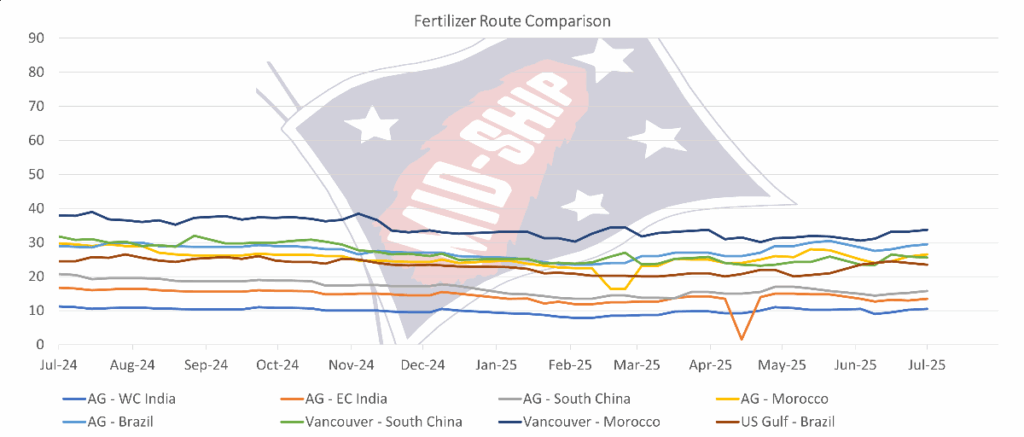
MID-SHIP Fertilizer – June 4, 2025

June 4, 2025

Market Overview:

The Summer season is upon us. Cape-size operators have run well this past week, while all other sectors operate at low levels. The U.S. Administration’s ‘fluid’ tariff policy is wreaking havoc with newly increased tariffs on steel and aluminum to start the new week.

Flooding in Western Australia is affecting Coal logistics for the Port of Newcastle.

Brazil imported 14.76 million metric tons of key commodities in Q1 2025 — a 12.55% drop year-over-year. This decline was driven by global price volatility in major products like iron ore, oil, soybeans, and sugar, alongside the depreciation of the Brazilian real, which raised import costs and reshaped trade dynamics.

U.S. consumer confidence rebounded sharply in May from an almost five-year low as perceptions of the economy and labor market improved.

The soft trend in fuel prices continues, reaching sub $500 per ton levels for Very Low Sulphur Fuel Oil (Singapore $499/Rotterdam $466). Brent traded flat at $64 on Monday after OPEC+ announced over the weekend the group would increase output in July by 411,000 b/d, the same amount the group has raised output by in the previous two months. An EIA report revealed that U.S. crude production increased by 250,000 b/d m-o-m in March to 13.49 million b/d, a record high. Kazakhstan has told OPEC+ it does not intend to lower its oil production and will produce at its capacity despite previously pledging it will compensate for past overproduction.


Subscribe below to receive the full report.


MID-SHIP Report: Dry Bulk Freight Market – May 22, 2025

May 22, 2025

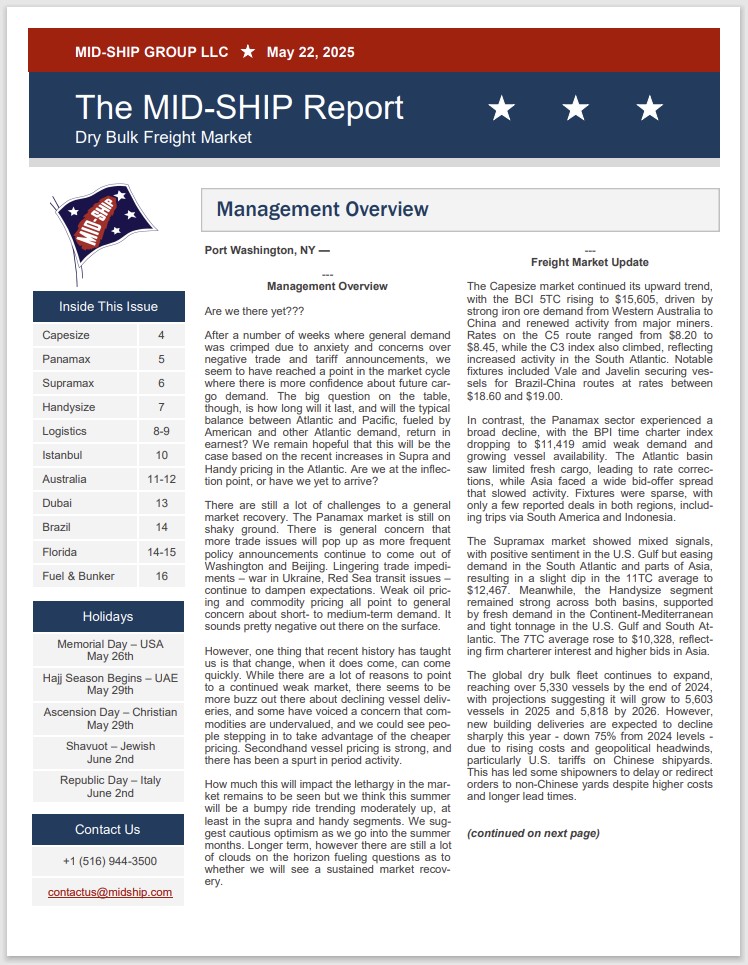
The Capesize market continued its upward trend, with the BCI 5TC rising to $15,605, driven by strong iron ore demand from Western Australia to China and renewed activity from major miners. Rates on the C5 route ranged from $8.20 to $8.45, while the C3 index also climbed, reflecting increased activity in the South Atlantic. Notable fixtures included Vale and Javelin securing vessels for Brazil-China routes at rates between $18.60 and $19.00.

In contrast, the Panamax sector experienced a broad decline, with the BPI time charter index dropping to $11,419 amid weak demand and growing vessel availability. The Atlantic basin saw limited fresh cargo, leading to rate corrections, while Asia faced a wide bid-offer spread that slowed activity. Fixtures were sparse, with only a few reported deals in both regions, including trips via South America and Indonesia.

The Supramax market showed mixed signals, with positive sentiment in the U.S. Gulf but easing demand in the South Atlantic and parts of Asia, resulting in a slight dip in the 11TC average to $12,467. Meanwhile, the Handysize segment remained strong across both basins, supported by fresh demand in the Continent-Mediterranean and tight tonnage in the U.S. Gulf and South Atlantic. The 7TC average rose to $10,328, reflecting firm charterer interest and higher bids in Asia.

The global dry bulk fleet continues to expand, reaching over 5,330 vessels by the end of 2024, with projections suggesting it will grow to 5,603 vessels in 2025 and 5,818 by 2026. However, new building deliveries are expected to decline sharply this year – down 75% from 2024 levels – due to rising costs and geopolitical headwinds, particularly U.S. tariffs on Chinese shipyards. This has led some shipowners to delay or redirect orders to non-Chinese yards despite higher costs and longer lead times.


Subscribe below to receive the full report.

MID-SHIP Petcoke Report – May 21, 2025

May 21, 2025

Market overview:  

Despite being finalized in April, the U.S. Trade Representative’s (USTR) new port fees targeting Chinese-built vessels continue to face strong backlash from the shipping industry, even during unrelated hearings on proposed crane tariffs. Industry groups like the World Shipping Council and the Chamber of Shipping of America argue the fees will raise costs for U.S. exporters and consumers, disrupt supply chains, and fail to influence China’s maritime policies. Many stakeholders also expressed confusion over the fee structure and implementation timeline, urging USTR to delay enforcement and seek broader industry input – our team will keep you posted on future developments.

This week, Brent crude oil prices showed a modest uptick, with the current spot price at $65.02 per barrel, reflecting a 0.69% increase from last week’s level of $64.94. Despite this slight weekly gain, the market remains under pressure from broader macroeconomic concerns and ongoing volatility in global demand forecasts. Compared to earlier in May, prices have been fluctuating within a narrow band, suggesting cautious sentiment among traders amid geopolitical and supply-side uncertainties. The downward trend reflects broader market volatility, with prices having fallen over 22% year-on-year, underscoring persistent pressure on the oil market despite recent short-term gains.


Subscribe below to receive the full report.


MID-SHIP Cement Report – May 13, 2025

May 13, 2025

Market Overview: 

With many participants in Copenhagen this week, it has been a relatively quiet start to the week for the dry bulk market. Overall, sentiment is cautiously optimistic. The consensus is that the market will improve on the back of the recent tariff news, which we have seen already in the Pacific, and talk that the US Gulf will likely improve here in the coming weeks ahead as more spot ships start to clear out.

The recent US-China tariff agreement marks a significant de-escalation in their ongoing trade war, with both countries agreeing to reduce or suspend many of the tariffs imposed earlier. The US will lower tariffs on Chinese imports from 145% to 30%, while China will reduce tariffs on US goods from 125% to 10% and also scrap non-tariff measures like export restrictions on critical minerals. Although some tariffs remain, including a 20% US surcharge targeting fentanyl-related concerns, the deal reflects a mutual desire to avoid economic decoupling and resume negotiations.

If no further agreement is reached, tariffs could partially return after 90 days, but at lower levels than before. The truce has been welcomed by markets, especially in the shipping sector, and is seen as a step toward stabilizing global trade. However, both sides are claiming victory, and the long-term outcome remains uncertain, with China perceived to be in a stronger negotiating position.

As of May 13, the Brent crude oil price is approximately USD 65 per barrel, reflecting a 3.75% increase from the previous trading day and a nearly 10% rise over the past week. This surge is largely attributed to renewed optimism following the US-China tariff truce, which has eased trade tensions between the world’s two largest oil consumers and boosted market confidence. Also noteworthy, the UK announced it would impose another sanctions package on Russia, targeting several directors of oil trading at 2RiversGroup and around 100 oil tankers linked to Russia’s ‘dark’ fleet, as part of efforts to tighten pressure on Moscow over the Ukraine conflict.


Subscribe below to receive the full report.

MID-SHIP Report: Dry Bulk Freight Market – May 7, 2025

May 7, 2025

The Cape market continues to soften across both basins, with Chinese dry bulk demand under pressure and seaborne iron ore volumes plateauing in 2025. The outcome of U.S.-China trade negotiations remains critical to China, the broader dry bulk market, and the Cape market specifically. Despite a positive run since April 23, momentum was dampened by last week’s May Day holidays.

The Panamax Time Charter Average has remained stable at approximately $12,000 daily for the past two weeks. However, shipowners are offering discounts on forward positions, signaling caution and potential further softening before recovery. In the Atlantic basin, previously trading at a discount to the Pacific, a vessel shortage has reversed this trend, with the Atlantic now commanding a 20% premium, though liquidity remains lower. South America is positioning to capitalize on U.S. tariffs and the upcoming grain season, despite subdued Chinese iron ore imports due to economic challenges. Strong soy imports into China, driven by Brazil’s large harvest, are expected to continue into Q2, supporting Panamax tonne-mile demand and freight rates.

After several weeks in decline, the Supramax market seems to have stabilized in certain pockets and strengthened in others as many feel that this market segment hit bottom and is starting into a period of limited recovery. Trans Atlantic rates have risen buoyed by increased demand in East Coast South America – heavily supported by grain exports. While there has been a noticeable drop in pricing for trips inbound to the Atlantic and from the Mediterranean, this is probably attributable to a combination of reduced demand and a resumption of more traditional backhaul trading with USG pricing showing signs of recovery.

Handy pricing and expectations are cloudier than what we are currently seeing for the Supramax sector. While there are similar patterns of small recoveries in the Atlantic, repositioning pricing is still relatively low and has not rebounded in the same way. Persistent holidays over the last 2 weeks have added to a lackluster recovery and general demand factors for smaller bulk are crimping demand for these ships. This is one area where tariff discussions may be having a larger impact than originally predicted.

OPEC+ announced an output increase, adding downward pressure on oil prices amid macroeconomic concerns.

In the U.S. domestic market, high water restrictions persist along the Mississippi River, with levels not expected to fall below the high-water threshold until late May. Heavy delays are anticipated for northbound Gulf departures through May, compounded by severe delays from Cairo to Chicago following the Lockport Lock closure. Carriers are addressing backlogs, but tow size and daylight restrictions continue to slow progress. The USDA reported grain barge freight for St. Louis to New Orleans at 350.94% of tariff for the week ending April 29, 2025. Barged grain movements totaled 670,133 tons for the week ending April 26, up 43% from the prior week and 52% from the same period last year.


Subscribe below to receive the full report.


MID-SHIP Fertilizer – May 6, 2025

May 6, 2025

Market Overview:

The overhang of holidays (May Day, Golden Week in Japan, April 29th/May 5th, and the UK Bank Holiday today) has kept a cap on market activities and the spot market. This lag was reflected in trading within a very narrow range last week and today to start the new trading session.

As we start the week, many are returning from long weekend holidays. The market opened steady to flat with mixed sentiment across both basins.

OPEC+ announces a hike in output, which continues to pressure the price of oil amid macroeconomic concerns.

The Cape market showed signs of life, particularly within the Pacific rim. Panamax enjoys steady demand from grain trades, both front haul and transatlantic. Meanwhile, other segments lacked luster and traded sideways to down slightly. There are too many ships… generally speaking.

On May 1, 2025, the Mediterranean SOx Emissions Control Area (ECA) was officially implemented. This regulation mandates that ships operating within the designated area must utilize fuel with a sulphur content not exceeding 0.1%. Alternatively, vessels may employ exhaust gas cleaning systems to achieve an equivalent SOx emission level, ensuring compliance with the stringent environmental standards set forth by the International Maritime Organization (IMO) under MARPOL Annex VI, Regulation 14.

The S&P 500 ultimately ended the tumultuous month of April about 0.8% lower, and the NASDAQ closed out 0.85% higher. The Dow was down about 3.2% in April.


Subscribe below to receive the full report.