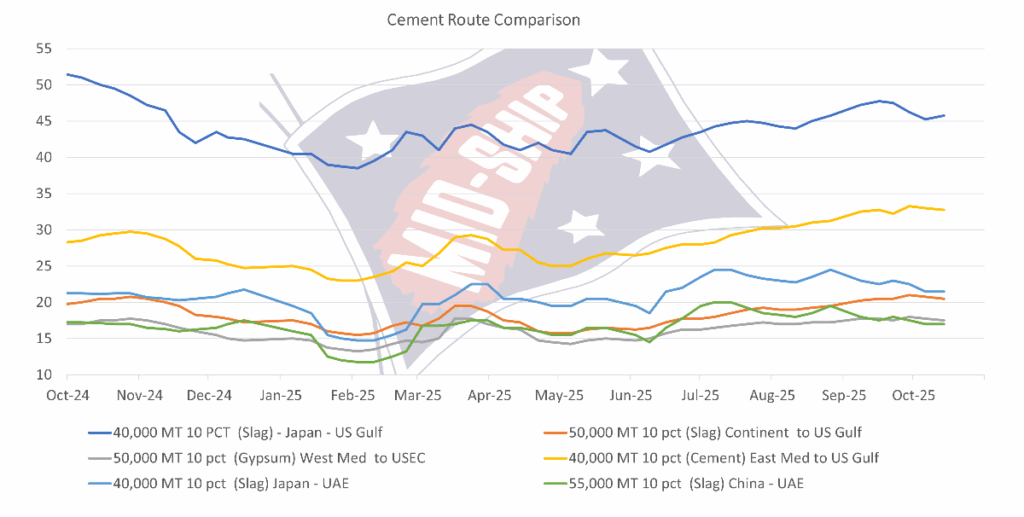
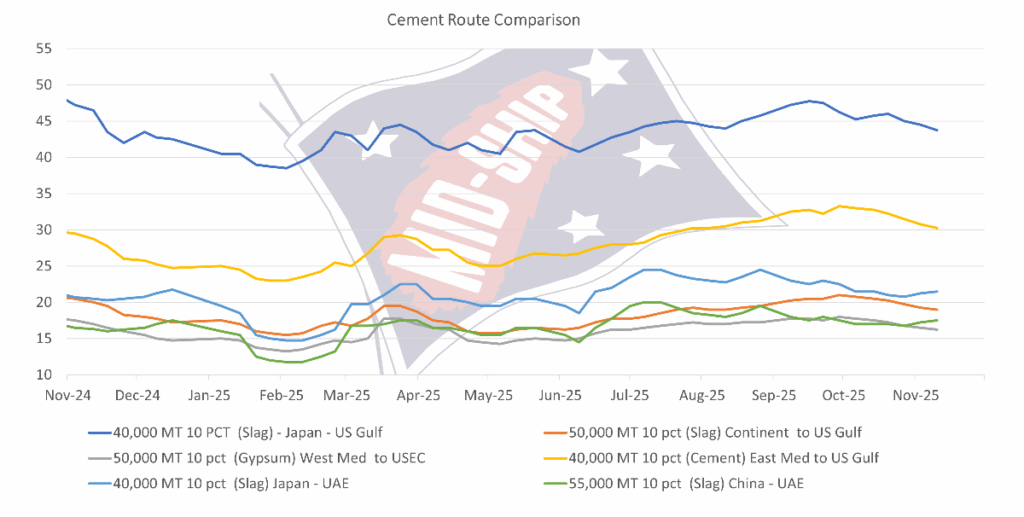
MID-SHIP Cement Report – November 10, 2025

November 10, 2025

Market Overview: 

We ended the prior week for Capes (180,000 DWT) on Friday, October 31, at $24,288, up from $23,811 the week before. The market saw an increase throughout the previous week and ended the week on a positive note. On Monday, we stood at $23,955 (up slightly from $23,534 the previous Monday), averaged $25,573 mid-week, and finished at $27,709 on November 7. The Time Charter Average begins this week at $27,063. The FFA curve on Monday shows November at $25,818 (up from $23,396 for November a week earlier) and December at $25,411 (up from December a week before $24,346). Q4 is now at $25,224 (up from $24,062 last week). The Cape market continues to be driven by iron ore pricing and Chinese import volumes. The benchmark Brazil-to-China voyage increased slightly throughout the week and opened this Monday at $23.30.

The Panamax market saw a decrease last week, with daily averages ranging between $16,207 and $16,501. The Trans-Atlantic round is currently assessed at $16,323 (down slightly from $16,709 one week ago), and the Pacific round for a Baltic type is at $17,226 (up from $16,263 one week ago). On Friday, October 31, the time-charter average traded at $16,389. To start this week, the spot average on Monday is $16,601 per day. Forward levels indicate $16,847 for November and $16,965 for December. Q4 is estimated at $16,683, and Q1 2026 is assessed at $14,647 daily.

The Supramax market traded within a narrow range last week. We started last week’s physical market with the Supra 63 at $16,688. The segment moved down slightly to $16,515 at mid-week, and ended the week at $16,678. We begin this week at $16,777. The U.S. Gulf-to-Asia benchmark front-haul for the Supra 63 is assessed at $28,739. Forward levels show November at $17,016, December at $17,198, and Q4 at $17,307 (up from $16,699 last week). Q1 2026 is estimated at $14,490.

Handy-size rates are dropping slightly from last week. The daily average rates moved from $15,131 to $14,582, and we start the new week at a slightly reduced $14,567. The U.S. Gulf-to-Europe trip is assessed at $19,246 (down from $20,971 the prior week). The spot physical market continued to be positional (regional market specific) and volatile based on cargo size and dates. Forward averages stand at $14,590 for November and $14,340 for December. The Q4 average assessment indicates $14,875. Then, in Q1 2026, the average estimated value increased to $11,383.


Subscribe below to receive the full report.


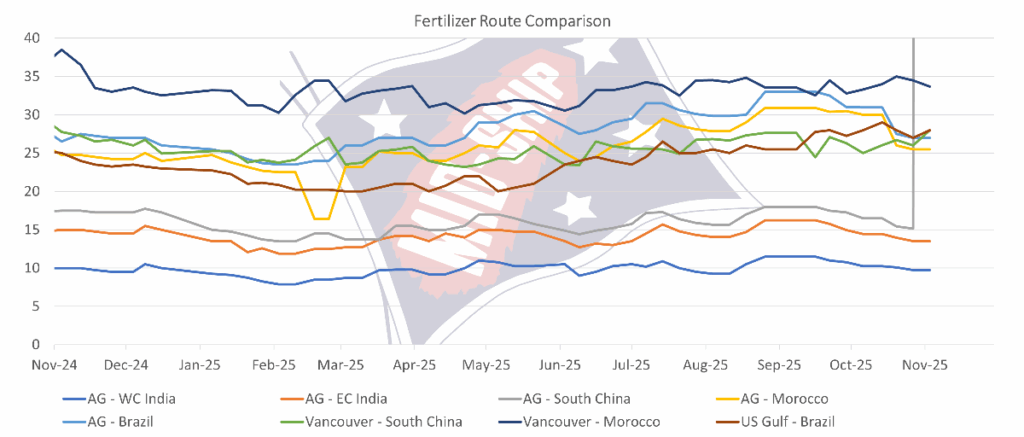
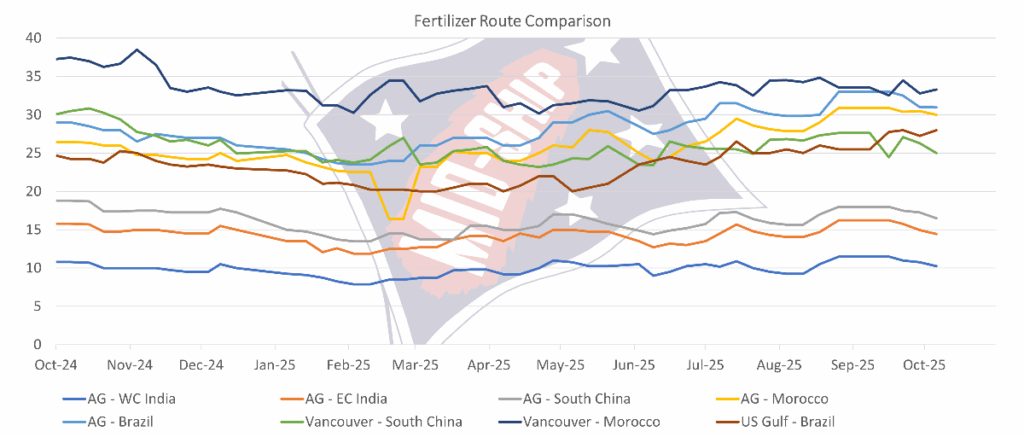
MID-SHIP Fertilizer – November 3, 2025

November 3, 2025

Market Overview:

We ended the prior week for Capes (180,000 DWT) on Friday, October 24, at $23,811, down from $25,882 the week before. The market faced unstable conditions from Monday through Wednesday before regaining momentum and ending the week on a positive note. On Monday, we stood at $23,534 (down from $25,944 the previous Monday), averaged $23,580 mid-week, and finished at $24,288 on October 31. The Time Charter Average begins this week at $23,955. The FFA curve on Monday shows November at $23,396 (down from $24,400 for October a week earlier) and December at $24,346 (down from November $24,721). Q4 is now at $24,062 (from $24,583 last week), suggesting near-term caution but a constructive outlook toward year-end. The Cape market continues to be driven by iron ore pricing and Chinese import volumes. The benchmark Brazil-to-China voyage was mixed throughout the week and opened at $23.01, with signs of positional strength.

The Panamax market improved last week, with daily averages ranging between $17,292 and $16,962. The Trans-Atlantic round is currently assessed at $16,709 (down from $18,623 one week ago), and the Pacific round for a Baltic type is at $16,263 (down from $17,565 one week ago). On Friday, October 24, the time-charter average traded at $17,318. To start this week, the spot average on Monday is $16,207 per day. Forward levels indicate $16,111 for November and $16,257 for December. Q4 is estimated at $16,647, and Q1 2026 is assessed at $14,104 daily.

The Supramax market traded within a narrow range last week. We started last week’s physical market with the Supra 63 at $17,208. The segment moved down to $16,966 at mid-week, and ended the week at $16,762. We begin this week at $16,688. The U.S. Gulf-to-Asia benchmark front-haul for the Supra 63 is assessed at $26,546. Forward levels show November at $16,227, December at $16,163, and Q4 at $16,699 (up from $16,366 last week). Q1 2026 is estimated at $14,076.

Handy-size rates are dropping slightly from last week. The daily average rates moved from $15,736 to $15,243, and we start the new week at a slightly reduced $15,131. The U.S. Gulf-to-Europe trip is assessed at $20,971 (down from $22,450 the prior week). The spot physical market continued to be positional (regional market specific) and volatile based on cargo size and dates. Forward averages stand at $14,470 for November and $14,220 for December. The Q4 average assessment indicates $14,795. Then, in Q1 2026, the average estimated value increased to $10,968.

A 27K metric tons stem was recently fixed via Brazil to USG, laycan Mid-November was done around USD 37.50 per metric tons. Canpotex is out with their usual NOPAC to Singapore /Japan or ECSA options for TCT. Understand last week Canpotex fixed an Ultramax basis delivery Far East at USD 11K DOP.


Subscribe below to receive the full report.


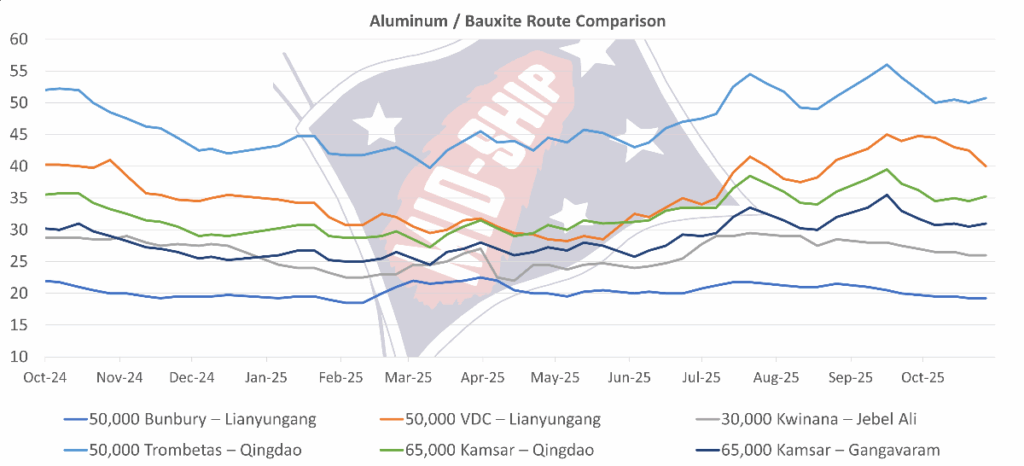
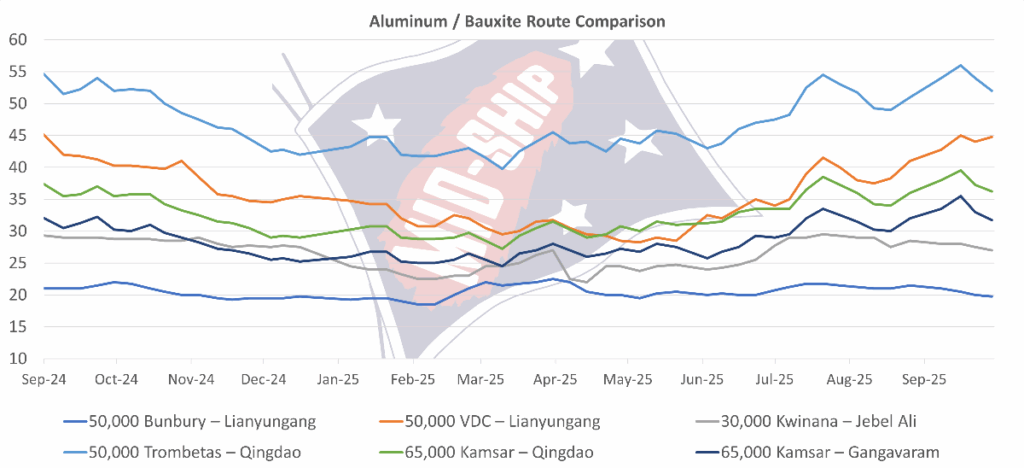
MID-SHIP Alumina/Bauxite – October 27, 2025

October 27, 2025

Market Overview: 

We ended the prior week for Capes 180,000 DWT on Friday, October 17, at $25,882 (up from $23,216 a week earlier). The market moved up from Monday to Wednesday and then trailed off a bit during the balance of the week. On Monday, last week, we were at $25,944 (down from $28,132 the prior Monday). The average was $26,199 by mid-week and ended the week at $23,811 on October 24. The Time Charter Average starts this week at $23,534. Monday’s FFA forward curve points to October assessed at $24,400 (down from $25,675 a week ago). November at $24,721 (down from $27,507). Q4 at $24,583 (down from $26,290 one week earlier), indicating some apprehension nearby and a relatively good outlook regarding the Cape market for the year’s end. This market continues to be heavily influenced by the price of iron ore and by import volumes to China. The benchmark Brazil to China voyage was mixed throughout the week and assessed at $22.76 to start the new trading week, with indications of positional strength.

The Panamax physical market was improved last week, and the daily average trading was between $16,460 and $17,318. The Trans-Atlantic round is currently assessed at $18,623 (up from $17,173 one week ago). In the Pacific, a round voyage for a Baltic type is estimated at $17,565 (also improved as compared to one week before). On Friday, October 17, the time charter average traded at $16,446. To start the new week, the spot average on Monday was $17,292 per day. The forward curve indicates $16,179 for October, $16,243 for November. Q4 is estimated at $15,911, and Q1 2026 is assessed at $12,857 daily.

The Supramax market traded within a narrow range last week. We started last week’s physical market with the Supra 63 at $17,969. The segment moved to $17,653 at mid-week and ended the week at $17,303; to start the new session, we are at $17,208. We start the week with the benchmark front haul rate in the market (U.S. Gulf to Asia) for the Supra 63, which was assessed at $26,689. The October forward assessment is $17,684, November is at $15,877, and Q4 is assessed at $16,366, down from $16,828 one week ago; Q1 2026 is estimated at $12,901.

The Handy-size market improved last week, continuing its firm trend, but trading within a very narrow range on average. The daily average rates moved from $15,914 to $15,812, and we start the new week at slightly reduced $15,736. The trip from the U.S. Gulf to Europe was assessed at $22,450 (down a tick from $23,814 the prior week). The spot physical market continued to be positional (regional market specific) and volatile based on cargo size and dates. The forward average of the daily time charter routes points to a slightly lower level to finish October at $15,660 and November at $14,340. The Q4 average assessment indicates $14,693. Then Q1 disappoints, moving down to $10,787.

Overall, the market was mixed at the start of the new week, with continuing concern for trade tensions between the U.S. and China and a distraction in the form of spirited IMO debate about the speed and quality of emissions reduction.


Subscribe below to receive the full report.


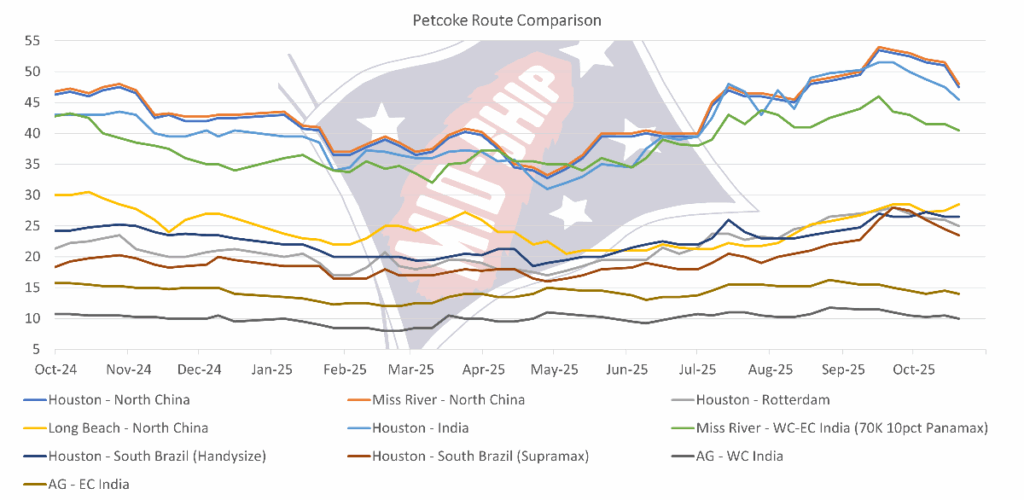
MID-SHIP Petcoke Report – October 20, 2025

October 20, 2025

Market overview:  

We ended the prior week for Capes 180,000 DWT on Friday, October 10th, at $23,216 (up from $22,595 a week earlier). The market moved up on Monday and then trailed off a bit during the balance of the week. On Monday, last week, we were at $28,132 (up from $23,453 the prior Monday). The average was $24,185 by mid-week and ended the week at $25,882 on October 17th. The Time Charter Average starts this week at $25,944. Monday’s FFA forward curve points to October assessed at $25,675 (down from $27,996 a week ago). November at $27,507 (down from $29,604). Q4 at $26,290 (down from $28,076 on week earlier), indicating some apprehension nearby and a relatively good outlook regarding the Cape market for the year’s end. This market continues to be heavily influenced by the price of iron ore and by import volumes to China. The benchmark Brazil to China voyage was mixed throughout the week and assessed at $24.51 to start the new trading week, with indications of positional strength.

The Panamax physical market was improved last week, and the daily average trading was between $14,886 and $15,873. The Trans-Atlantic round is currently assessed at $17,173 (up from $15,045 one week ago). In the Pacific, a round voyage for a Baltic type is estimated at $16,255 (also improved as compared to one week before). On Friday, October 3rd, the time charter average traded at $14,961. To start the new week, the spot average on Monday was $16,257 per day. The forward curve indicates $16,743 for October, $16,707 for November. Q4 is estimated at $16,411, and Q1 2026 is assessed at $12,785 daily.

The Supramax market traded within a narrow range last week. We started last week’s physical market with the Supra 63 at $17,695. The segment moved to $17,921 at mid-week and ended the week at $17,996; to start the new session, we are at $17,969. We start the week with the benchmark front haul rate in the market (U.S. Gulf to Asia) for the Supra 63, which was assessed at $29,621. The October forward assessment is $17,877, November is at $16,488, and Q4 is assessed at $16,828 down from $17,485 one week ago; Q1 2026 is estimated at $13,076.

The Handy-size market improved last week, continuing its firm trend, but trading within a very narrow range on average. The daily average rates moved from $15,726 to $15,937, and we start the new week at slightly reduced $15,914. The trip from the U.S. Gulf to Europe was assessed at $23,814 (down a tick from $23,221 the prior week). The spot physical market continued to be positional (regional market specific) and volatile based on cargo size and dates. The forward average of the daily time charter routes points to a slightly lower level to finish October at $15,690 and November at $14,770. The Q4 average assessment indicates $14,877. Then Q1 disappoints, moving down to $10,817.

Overall, the market was mixed at the start of the new week, with continuing concern for trade tensions between the U.S. and China and distraction in the form of spirited IMO debate about the speed and quality of emissions reduction.


Subscribe below to receive the full report.


MID-SHIP Cement Report – October 14, 2025

October 14, 2025

Market Overview: 

We ended the week for Capes 180,000 DWT on Friday, October 3, at $22,595. The market moved up during the week. On Monday, last week, we were at $23,453. The average was $24,252 by mid-week and ended the week at $23,216. The Time Charter Average starts this week at $28,122. Monday’s FFA forward curve points to October assessed at $27,996. November is at $29,604. Q4 is at $28,076, indicating some optimism nearby and an improved outlook regarding the Cape market for the year’s end (as compared to just one week ago). This market continues to be heavily influenced by the price of iron ore and by import volumes to China. The benchmark Brazil to China voyage was mixed throughout the week and assessed at $23.70 to start the new trading week, holding steady as compared to last Monday.

The Panamax physical market was improved last week, and the daily average trading was between $14,886 and $15,873. The Trans-Atlantic round is currently assessed at $17,173 (up from $15,045 one week ago). In the Pacific, a round voyage for a Baltic type is estimated at $16,255 (also improved as compared to one week before). On Friday, October 3, the time charter average traded at $14,961. To start the new week, the spot average on Monday was $16,257 per day. The forward curve indicates $16,743 for October, $16,707 for November. Q4 is estimated at $16,411, and Q1 2026 is assessed at $12,785 daily.

The Supramax market traded down within a narrow range last week. We started last week’s physical market with the Supra 63 at $18,239. The segment moved to $17,832 at mid-week and ended the week at $17,719; to start the new session, we are at $17,695. We start the week with the benchmark front haul rate in the market (U.S. Gulf to Asia) for the Supra 63, which was assessed at $29,921, down only slightly from the prior week’s $30,950. The October forward assessment is $18,020, November is at $17,655, and Q4 is assessed at $17,485; Q1 2026 is estimated at $13,378.

The Handy-size market improved last week, continuing its firm trend, but trading within a very narrow range on average. The daily average rates moved from $15,600 to $15,713, and we start the new week at an improved $15,726. The trip from the U.S. Gulf to Europe was assessed at $23,221 (up from $22,229 the prior week). The spot physical market is positional (regional market specific) and volatile based on cargo size and dates. The forward average of the daily time charter routes points to a slightly higher level to finish October at $15,840, and November at $15,260 (up from $ 14,030 a week ago). The Q4 average assessment indicates $15,113 (also up from $14,127 one week ago). Then Q1 disappoints, moving down to $10,973 (down from $12,120 per day one week ago).

Overall, the market was mixed at the start of the new week, due to renewed trade tension between the U.S. and China.


Subscribe below to receive the full report.


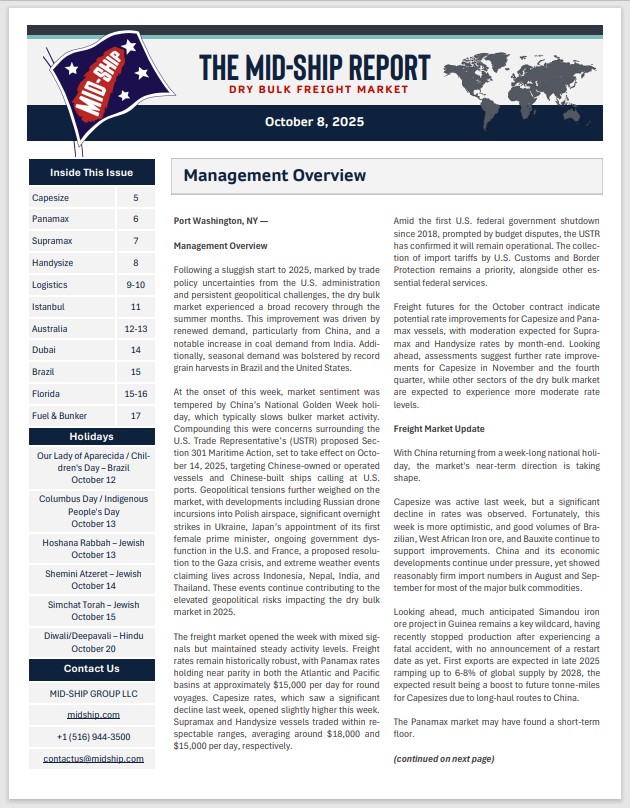
MID-SHIP Report: Dry Bulk Freight Market – October 8 2025

October 8, 2025

With China returning from a week-long national holiday, the market’s near-term direction is taking shape.

Capesize was active last week, but a significant decline in rates was observed. Fortunately, this week is more optimistic, and good volumes of Brazilian, West African Iron ore, and Bauxite continue to support improvements. China and its economic developments continue under pressure, yet showed reasonably firm import numbers in August and September for most of the major bulk commodities.

Looking ahead, much anticipated Simandou iron ore project in Guinea remains a key wildcard, having recently stopped production after experiencing a fatal accident, with no announcement of a restart date as yet. First exports are expected in late 2025 ramping up to 6-8% of global supply by 2028, the expected result being a boost to future tonne-miles for Capesizes due to long-haul routes to China.

The Panamax market may have found a short-term floor.

Reaching parity of both Atlantic and Pacific rounds. Since mid-September, the Time Charter Average has declined by nearly 20% and is now testing the support level of USD 15,000 per day. In the Pacific, thanks to a strong North Pacific export market, increased iron ore shipments from Australia, and steady coal flows from Indonesia, rates have moved up. In the Atlantic, tariff uncertainty, trade war with China, and pending USTR fees have seen Atlantic rates decline about 30% or USD 7,000 since mid-September.

The Supramax segment has seen a fair amount of activity this week, showing little overall change from previous levels. Despite steady cargo volumes in several regions, market confidence has eased as the Baltic Supramax Index (BSI) slipped for the seventh straight session, settling near 1,411 points. Meanwhile, the Baltic Dry Index advanced by around 2% to a one-week high, reflecting stronger conditions in the larger vessel classes. The divergence between these indices highlights the current imbalance within the dry bulk sector, as Supramax earnings remain capped, while Capesize and Panamax ships capture the majority of the upside. The Atlantic opened the week with a steady undertone, supported by consistent grain and mineral loadings from Brazil and Argentina. Trading in Asia quieted considerably as China’s Golden Week curtailed demand and limited new fixtures. In the Mediterranean and Black Sea, conditions are relatively stable. As October progresses, the market’s trajectory will likely depend on post-holiday demand in Asia and the sustainability of Brazil’s export momentum.

The Handy market over the last two weeks has been steady despite Holidays in the Pacific and well-attended Miami ASBA + Houston breakbulk conferences in the U.S. The Baltic daily index of the 7TC routes for 38,000 DWT Handy is up USD 1,212 per day since our last report, with today’s average at USD 15,631.

Period interest remains low, with most shipowners opting to trade on the spot market rather than locking in long-term deals at current low levels.

Container rates have hit their lowest levels since January 2024, according to the Drewry World Container Index.

As we step into October, the shipping market in the Mediterranean and Black Sea regions enters a transitional phase. After an unusually dynamic start to September — driven largely by short-term cargo movements and sporadic spot activity — the remainder of the month showed signs of stabilization. Although the market lacks the strong cargo flow typically expected during this period, the relative scarcity of spot-seeking vessels has prevented freight levels from softening significantly. This balance between limited demand and tight tonnage availability is a clear indication that much of the market is being sustained through off-market fixtures and repeated contractual voyages. These “invisible” trades, often executed between long-standing charterer–owner relationships, are helping maintain a sense of continuity in an otherwise muted environment. Despite the absence of high spot cargo volumes, this underlying business provides a level of resilience to the freight market.

In the South Pacific, the Handy and Supramax/Ultramax segments have shown strong performance since July, steadily climbing rates. At their recent peaks, Handy-size vessels were closing in on USD 14,000/day, while Ultramax vessels were reaching USD 17,000/day basis delivery in Southeast Asia and the Far East. However, this upward momentum has begun to moderate. The market is now undergoing a correction, with time charter rates easing and trading ranges narrowing. While spot rates remain firm, it is essential not to overlook the sentiment in forward markets — futures for both Handies and Supras are pricing in significantly softer conditions, with Baltic FFA values for December and Q1 2026 trading around 30% below current spot levels. This underscores growing caution among market participants heading into year-end.

In the inland market in the USA, low water is restricting barge traffic along the inland river system for the 3rd grain season in a row. At the confluence of the Ohio and Mississippi rivers in Cairo, IL, river levels have dropped 9 feet below the 10-year average, with New Orleans reporting its lowest levels in 10 years as well. The restrictions that will follow will severely limit not only the volume to be loaded in barges, but the amount of barges any single towboat may take on a voyage. The restrictions and low water event are expected to hold a firm grip through October and well into November.

Importers are rushing to create bonded warehousing space in the U.S. as the current Administration’s tariffs continue to crack down on shipments from China and the rest of the world. Many of the 1,700 bonded warehouses in the U.S. are at capacity, prompting a mass application by companies to expand bonded space with the U.S. Customs and Border Patrol. In early 2024, bonded storage space was often priced at approximately twice the cost of standard storage, but since the start of 2025, some bonded storage has risen to four times the price, according to industry data.

The rise in one US truck pricing index last month shows that shippers are balancing current capacity needs and future demand rather than taking advantage of a soft freight market to demand lower prices in the short term. The truckload producer price index (PPI) rose 1.8% in August from July, while the less-than-truckload PPI expanded 1.5% within the same period, according to the US Bureau of Labor Statistics (BLS).


Subscribe below to receive the full report.

MID-SHIP Fertilizer – October 6, 2025

October 6, 2025

Market Overview:

We ended the week for Capes 180,000 DWT on Friday, September 26, at $30,076. The market was volatile to the downside throughout the week. On Monday, last week, we were at $29,228. The average was $23,968 by mid-week and ended the week at $22,595. The Time Charter Average starts this week at $23,453. Monday’s FFA forward curve points to October assessed at $26,007. November at $26,821. Q4 at $25,980, indicating some optimism nearby and doubt regarding the Cape market for the year’s end. This market continues to be heavily influenced by the price of iron ore and by import volumes to China. The benchmark Brazil to China voyage was mixed throughout the week and assessed at $23.97 to start the new trading week, dropping from almost $26.00 last Monday.

The Panamax physical market was a bit softer last week, and the daily average trading was between $16,358 and $14,961 (as compared to a range of $18,027 to $16,603 two weeks ago). The Trans-Atlantic round is currently assessed at $15,045. In the Pacific, a round voyage for a Baltic type is estimated at $15,145. On Friday, September 26, the time charter average traded at $16,484. To start the new week, the spot average on Monday was $14,886 per day. The forward curve indicates $15,545 for October, $15,154 for November. Q4 is estimated at $15,115, and Q1 2026 is assessed at $12,453 daily.

The Supramax market again traded within a narrow range last week. We started last week’s physical market with the Supra 63 at $18,683 (as compared to $18,869 two weeks ago). The segment moved to $18,537 at mid-week and ended the week at $18,288; to start the new session, we are at $18,239. We start the week with the benchmark front haul rate in the market (U.S. Gulf to Asia) for the Supra 63, which was assessed at $30,950 – down from $31,350 two weeks prior. The October forward assessment is $17,555, November is at $15,889, and Q4 is assessed at $16,240; Q1 2026 is estimated at $14,891.

The Handysize market improved last week, continuing its firm trend. The daily average rates moved from $15,296 to $15,616 (up from $14,482 to $14,671 two weeks ago), and we start the new week at a steady $15,600. The trip from the U.S. Gulf to Europe was assessed at $22,229 (up from $20,393 two weeks ago). The spot physical market continued to be positional (regional market specific) and volatile. The forward average of the daily time charter routes points to slightly softer levels to finish October, and November looks lower at $14,030. The Q4 average assessment indicates $14,127, up from $13,390 two weeks ago. Then Q1 disappoints, moving down to $12,120 per day.

Overall, the market remained optimistic at the start of the new week and was supported by grain and mineral activities.


Subscribe below to receive the full report.


MID-SHIP Alumina/Bauxite – September 29, 2025

September 29, 2025

Market Overview: 

As we enter October, the dry bulk freight market presents a mixed picture, with strong spot rates across all segments tempered by historical seasonal headwinds. October has traditionally been a softer month for dry bulk freight, with the Baltic Dry Index declining in nine of the past ten years during this period. This trend often follows a robust September, and current futures pricing reflects this pattern – Panamax and Supramax futures are trading below spot levels, suggesting market participants expect a near-term pullback. Capesize futures, however, remain more aligned with spot rates, indicating continued optimism in that segment. While short-term softness may emerge, the broader outlook remains constructive, supported by strong cargo flows into China, limited vessel availability due to fleet inefficiencies, and a generally positive sentiment toward commodities and global shipping.

Iron ore imports into China have rebounded following a weak first half, bringing year-to-date totals down less than 2%. Brazilian exports are up approximately 5% year-to-date, boosting tonne-mile demand and contributing to Capesize strength. Inventories remain lower year-over-year but are broadly in line with historical averages. However, the trajectory of Chinese steel production – particularly at blast-furnace mills – will be a key determinant of future iron ore trade and Capesize rates. As always in shipping, rate movements are driven more by marginal demand and vessel availability than total cargo volume.

Geopolitical developments continue to shape the long-term outlook. China has temporarily banned purchases of dollar-denominated iron ore cargoes from BHP amid a pricing dispute, adding uncertainty to the iron ore trade. This move follows failed negotiations between BHP and China Mineral Resources Group, a state-run entity created to increase China’s influence in global iron ore pricing. Iron ore futures rose on the news, but the broader implications will depend on how quickly the dispute is resolved.

In the Panamax segment, market activity remains unsettled. North Atlantic rates have softened due to increased tonnage, and trips from the U.S. East Coast have eased despite healthy inquiry levels, as upcoming holidays in China, Hong Kong, and Korea weigh on sentiment. Ore cargoes from Australia are reportedly in good supply but have had limited impact on rates. Notable fixtures include the Kerkyra (81,375 dwt) fixed at $17,000 daily for a trip via the St. Lawrence River, and SAIL’s booking of 75,000 tons of coal from Newport News to Visakhapatnam at $37.55 per metric ton.

Capesize trading has seen a downturn, particularly in the Pacific, where rumors of pricing disputes between BHP, Fortescue, and the Chinese government – though denied – have dampened sentiment. Rates on the key C5 route fell from $10.90–$10.50 to around $10.10 per metric ton. In the Atlantic, owners are conceding on rates to secure cover, with limited fresh inquiry reported. Recent fixtures include the Star Aqua (174,008 dwt) for Tubarao/W. Africa to China at $25.35 per metric ton, and Vale’s booking of 170,000 tons from Teluk Rubiah to Qingdao at $7.70 per metric ton.

Supramax and Handysize segments are experiencing mixed conditions. Supramax trading slowed ahead of the Chinese holiday, with Atlantic rates holding firm but Pacific rates softening due to limited cargo and excess tonnage. The Indian Ocean is similarly weighed down by prompt tonnage and lack of inquiry. Handysize routes in the Continent and Mediterranean firmed on good inquiry and short tonnage, while the U.S. Gulf and ECSA held steady. Canpotex recently fixed an Oldendorff TBN for 67,000–68,000 tons of MOP from Portland to China at $26.75 per metric ton.

Finally, China has revised its maritime transport regulations to counter USTR restrictions, allowing for retaliatory measures against countries imposing discriminatory bans or restrictions on Chinese shipping. These new rules, effective September 28th, may increase regulatory scrutiny and compliance burdens for international operators, particularly those with Chinese-built vessels or crew.

Overall, while October may bring short-term volatility, the dry bulk market remains on a constructive path, supported by stable commodity demand, constrained fleet growth, and the potential for a cyclical rebound in China’s economy.


Subscribe below to receive the full report.

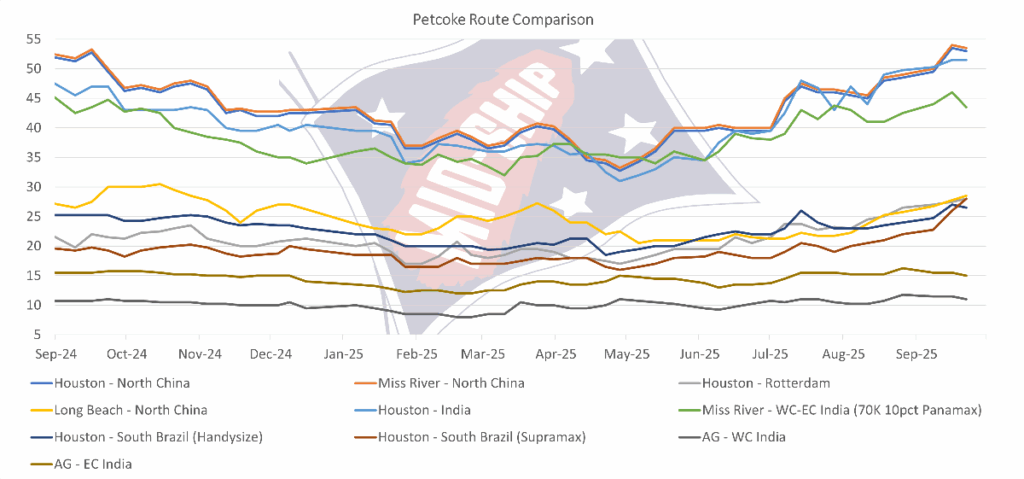
MID-SHIP Petcoke Report – September 22, 2025

September 22, 2025

Market overview:  

We ended the week for Capes 180,000 DWT on Friday, September 12, at $25,457, down from $27,376 on Friday one week ago. The market was volatile to the upside throughout the week. On Monday, last week, we were at $26,156 (down from $28,152 one week earlier). The average was $27,366 by mid-week (down from $29,505 a week earlier) and ended the week at $28,504 (down from $29,302 the week prior). The Time Charter Average starts this week at $27,903. Monday’s FFA forward curve points to September assessed at $26,704, and October at $30,500. Q3 is estimated at $24,818, and Q4 at $27,506, indicating doubt regarding the Cape market for the year’s balance. This market continues to be heavily influenced by the price of iron ore and by import volumes to China. The benchmark Brazil to China voyage was mixed throughout the week and assessed at $24.85 (up from $23.78 one week ago) to start the new trading week.

The Panamax physical market was mixed last week, and the daily average trading ranged from $18,027 to $16,603 (in a reversal of the prior week’s trend of $16,600 to $18,000). The Trans-Atlantic round is currently assessed at $18,795 (as compared to $22,955 one week earlier). In the Pacific, a round voyage for a Baltic type is estimated at $14,516 (down slightly from $14,659 a week earlier). On Friday, September 12, the time charter average traded at $18,056. The spot average is up a tick on Monday, to start the new week at $16,400 per day. The forward curve is indicating $16,782 for September and $16,154 for October. Q3 is estimated at $16,810, and Q4 2025 is assessed at $15,225 daily.

The Supramax market again traded within a narrow range last week. We started last week’s physical market with the Supra 63 at $18,869. The segment moved to $18,861 at mid-week and ended the week at $18,822; we are at $18,784. We start the week with the benchmark front haul rate in the market (U.S. Gulf to Asia) for the Supra 63, which was assessed at $31,350, up slightly from $31,186 a week ago. The September forward assessment is $18,545; October is $17,573, and Q3 is assessed at $17,073; Q4 is estimated at $15,225.

The Handy-size market was steady last week, continuing its firm trend. The daily average rates moved from $14,482 to $14,671 (up a bit from $14,203 to $14,475 one week ago), and we start the new week at a steady $14,703, up from $14,482 one week prior. The trip from the U.S. Gulf to Europe was up to $20,393, up from $19,950 as compared to one week ago. The spot physical market continued to be volatile. The forward average of the daily time charter routes points to slightly softer levels. September is assessed at $14,490. October at $13,810. The Q3 assessment indicates $13,012, and Q4 at $13,390.

Overall, the market remained optimistic at the start of the new week and was supported by grain and mineral activities.


Subscribe below to receive the full report.


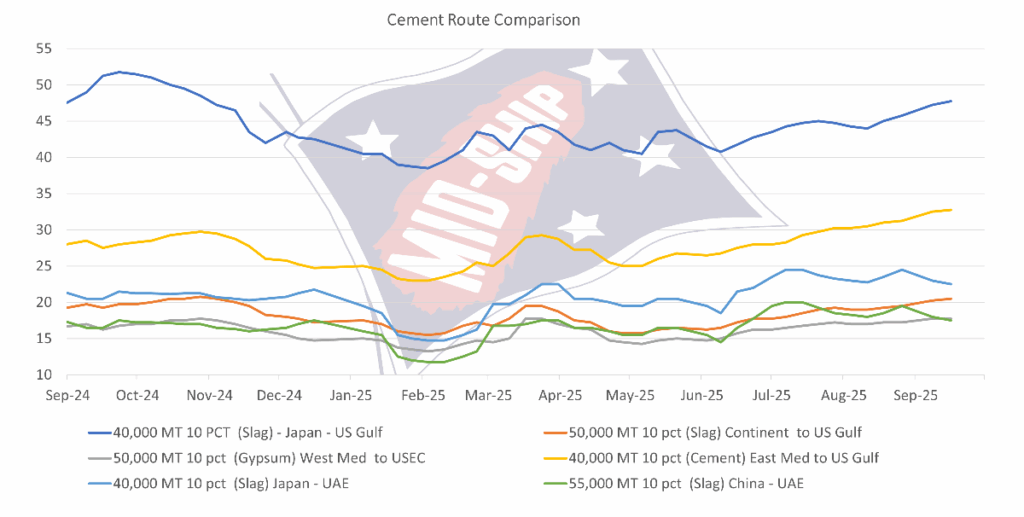
MID-SHIP Cement Report – September 15, 2025

September 15, 2025

Market Overview: 

We ended the week for Capes 180,000 DWT on Friday, September 5, at $27,376, up nicely from $24,257 in our last report one week ago. The market was volatile to the upside throughout the week. On Monday, last week, we were at $28,152 compared to $24,455 one week earlier. The average was $29,505 by mid-week and ended the week at $29,302. The Time Charter Average starts this week at $30,170. Monday’s FFA forward curve points to September assessed at $26,182 — October at $28,575. Q3 is estimated at $24,644, and Q4 at $26,573, indicating doubt regarding the Cape market for the year’s balance. This market continues to be heavily influenced by China. The benchmark Brazil to China voyage was mixed throughout the week and assessed at $23.78 to start the new trading week.

The Panamax physical market was firmer last week, and the daily average traded from $16,600 to $18,000, so it was firm to start the new week. The Trans-Atlantic round is currently assessed at $22,955. In the Pacific, a round voyage for a Baltic type is estimated at $14,659. On Friday, September 5, the time charter average traded at $16,221. The daily time charter average started last week at $16,613, traded up to $17,778 at mid-week, and $18,056 to end the week. The spot average is up a tick on Monday, to start the new week at $18,027. The forward curve is indicating $17,079 for September and $16,504 for October. Q3 is estimated at $16,909, and Q4 2025 is assessed at a lower $15,636 daily.

The Supramax market again traded within a firm, albeit in a narrow range, last week, and started the new week slightly improved. We started last week’s physical market with the Supra 63 at $18,499. The segment moved to $18,677 at mid-week and ended the week at $18,856; we are at $18,869. We start the week with the benchmark front haul rate in the market (U.S. Gulf to Asia) for the Supra 63, which was assessed at $31,186, up from $30,107 a week ago, and trading in the physical market continues to be volatile depending upon position and cargo size. The September forward assessment is $18,641; October is at $18,445, and Q3 is assessed at $17,105; and Q4 is estimated at $17,048.

The Handy-size market moved up last week. The daily average rates moved from $14,203 to $14,475 as compared to $14,019 to $14,165 a week ago, and we start the new week at a steady $14,482. The trip from the U.S. Gulf to Europe was up at $19,950, down from $20,214 as compared to one week ago. The spot physical market continued to be volatile. The forward average of the daily time charter routes points to slightly softer levels. September is assessed at $14,560. October at $14,240. The Q3 assessment indicates $13,035, up from $12,055 one week ago, and Q4 at $13,640 (steady).

Overall, the market remained optimistic at the start of the new week and the start of what is seasonally a better market.


Subscribe below to receive the full report.