MID-SHIP Report: Dry Bulk Freight Market – September 12 2025
September 12, 2025

Fundamentally, the market remains consistent with early 2025 conditions, characterized by a mature commodity cycle and potentially reduced volumes of both major and minor bulks, uncertainty due to geopolitical risk (Russia-Ukraine, Gaza, India-Pakistan), and the U.S. government’s global trade negotiations. The vessel fleet continues to grow moderately.

The largest vessels are enjoying a favorable supply-demand balance in 2025. The Cape size fleet growth is projected to be minimal this year, while ton-mile demand growth is expected to be above 3%. The Baltic Dry Index (BDI) and Cape size-specific indices are expected to remain volatile, with stronger performance in Q3 due to seasonal commodity demand but potential softening in Q4 if economic headwinds intensify. Projects like Guinea’s Simandou and West Australia’s Onslow enhance long-haul trade prospects. The benchmark route from Brazil to China is reported at over $24.00 per ton and heading north, as compared to $18.20 this time last month.

The Panamax market has been under pressure during the month of May, declining from $12,400 to $10,000 on average in the month. Fortunately, at least now, perhaps on a tailwind from the firm Cape market, but more likely strong demand for grain shipments originating in the Atlantic, both trans-Atlantic and Front Haul, and a pick-up in USEC to India Coal trades. China’s slowing demand has been driving Panamax rates in the Pacific down by 50% since April when prospects within the basin were significantly brighter. Now, Panamax is at parity in both basins.

The Supramax/Ultramax segment of the market has entered a more subdued phase after a previously bullish stretch. The U.S. Gulf, which had been a bright spot with Trans-Atlantic and petcoke runs commanding robust returns, is now showing signs of cooling. A growing number of open ships and a narrowing spread of viable cargoes are beginning to weigh on rates. Early June optimism has given way to a more measured outlook, with forward sentiment pointing to a softer second half of the month. A widening gap between vessel supply and cargo demand is becoming increasingly apparent in the Asia-Pacific region. While North Pacific rounds have held steady, Southeast Asia continues to lag behind expectations. Indonesian coal exports remain subdued as China’s push to stockpile more domestic coal while curbing imports has affected demand and added pressure to rates.

Since our previous report, the Handy size dry bulk market has remained subdued across both the Atlantic and Pacific basins, with limited fresh inquiries and an oversupply of prompt tonnage. While select submarkets have experienced modest gains, overall activity has been restrained. The positive momentum highlighted two weeks ago has persisted, with the U.S. Gulf maintaining its strength. The South Atlantic market has remained steady to firm, underpinned by balanced supply and demand dynamics. Activity in the Continent has been curtailed by national holidays. The Pacific market has held steady, though sentiment is softening due to a growing buildup of vessels in key loading areas. The North Pacific (NOPAC) saw increased activity this week, with rates edging slightly higher.

Cape size remains firm to end the current week, expect volatility nearby, and then look for directional trend as we approach the annual pre-winter restocking in China. The market began the week on a positive footing, with the BCI 5TC gaining $699 to close at $26,156. In the Pacific, sentiment was underpinned by three miners actively in the market alongside some fresh operator cargoes.

The Atlantic basin is leading in the Panamax market, trading at a 60% premium over the Pacific. The China/U.S. trade negotiations continue to be at the top of the minds of owners and operators in the sector. U.S. grain exporters have shifted their focus toward European buyers. The Pacific market has seen modest gains since early summer, rising from $11,000 to around $13,000 per day, with a short-lived peak of $15,000 in mid-July. On the period front, deals remain scarce, with shipowners reluctant to commit beyond a few months.

Supras and Ultras, while starting the new week in a relatively subdued manner, have been firm and continue to enjoy solid demand and a firm trend across all markets. We expect positional volatility to continue due to the finely balanced supply and demand this year.

The Handy-size markets continue to follow their “slow and steady” winning strategy. The market has recently traded up within a narrow range, repeating this aspect each week during the past several weeks. Strong grain exports continue to underpin this market.


Subscribe below to receive the full report.

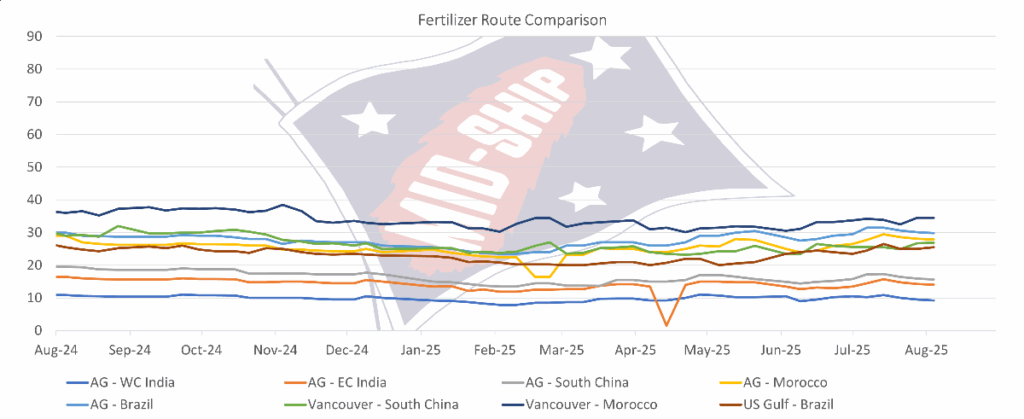
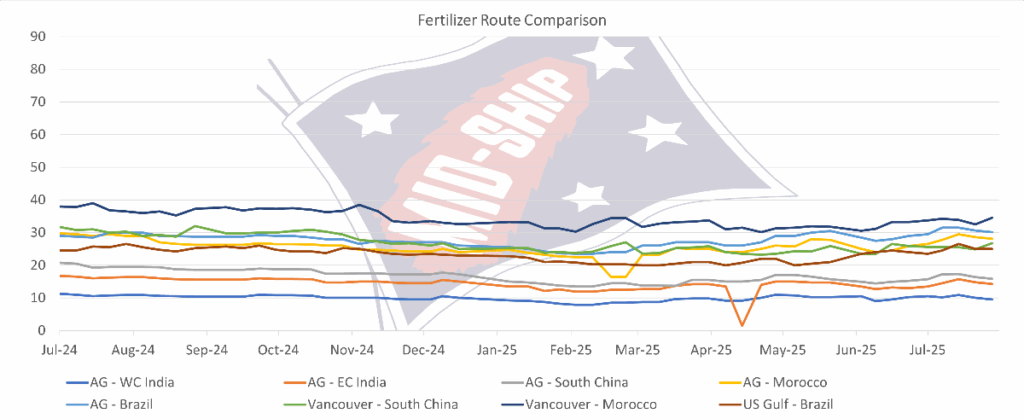
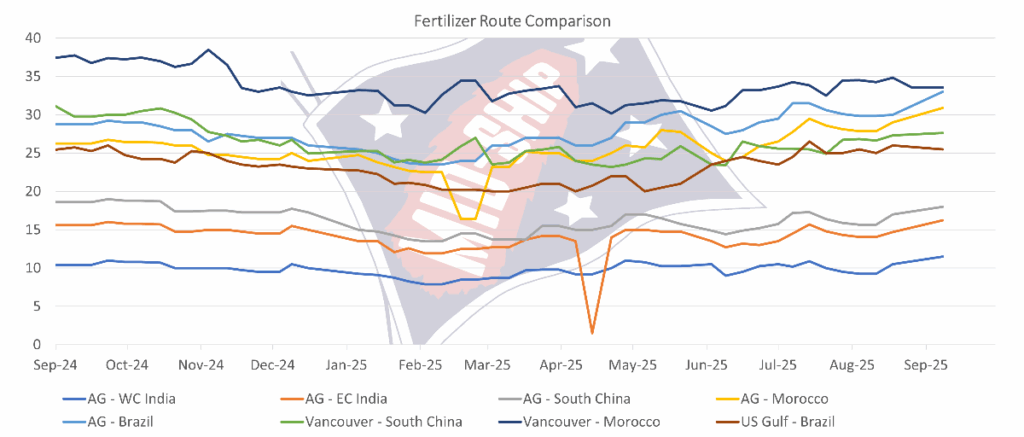
MID-SHIP Fertilizer – September 8, 2025

September 8, 2025

Market Overview:

We ended the week for Capes 180,000 DWT on Friday, August 29, at $24,257, down from $27,323 in our last report two weeks ago. The market was volatile throughout the week, trading in a narrow range and picking up from Thursday to Friday, similar to the prior week. On Monday, last week, we were at $24,455. The average was $22,994 by mid-week and ended the week at $23,513. The Time Charter Average starts this week at $24,150. Monday’s FFA forward curve points to September assessed at $26,392. October at $28,513. Q3 is assessed at $24,714, and Q4 at $26,414, indicating some trepidation at the moment in terms of the Cape market for the year’s balance. This market continues to be heavily influenced by China, where things are currently tough. The benchmark Brazil to China voyage was mixed throughout the week and stands at about $24.00 to start the new trading week.

While the Panamax market seemed firmer and improved last week, the daily averages traded within a narrow range and improved to start the new week. The Trans-Atlantic round is currently assessed at $21,018 (up from $17,855 two weeks ago). In the Pacific, a round voyage for a Baltic type is estimated at $13,741, down from $14,402 two weeks prior. On Friday, August 29, the time charter average traded at $16,623 (up from $14,601 two weeks ago in our last report). The daily time charter average started last week at $16,313, traded down to $15,500, and then recovered to $16,221 to end the week. The spot average is up a tick on Monday, to start the new week at $16,613. The forward curve moves up a bit in September and October, indicating $17,449 for September and $17,238 for October. Q3 is estimated at $17,033, and Q4 2025 is assessed at a lower $16,203 daily.

The Supramax market remained firm, trading along a narrow range last week, and starts the new week slightly improved. We started last week’s physical market with the Supra 63 at $18,539. The segment moved to $18,538 at mid-week and ended the week at $18,399; this Monday, we are at $18,499. We start the week with the benchmark front haul rate in the market (U.S. Gulf to Asia) for the Supra 63, which was assessed at $30,107, up from $28,454 two weeks ago, and trading in the physical market is volatile depending upon position and cargo size. The September forward assessment is $19,035 (steady as compared to $19,042 two weeks ago); October is at $18,938, and Q3 is assessed at $17,236; and Q4 is estimated at $17,471.

The Handy-size market moved up last week. The daily average rates moved from $14,019 to $14,165 as compared to $12,635 to $13,054 two weeks ago, and we start the new week at a steady $14,203. The trip from the U.S. Gulf to Europe was up at $20,214 as compared to $17,721 prior to the Labor Day Holiday. The spot physical market continued in a volatile position to the upside. The forward curve of the average of the time charter daily routes points to slightly improved levels. September is assessed at $14,620. October at $14,740. The Q3 assessment indicates $12,055, and Q4 at $13,890.

Overall, the market continued to be optimistic at the start of the new week.


Subscribe below to receive the full report.


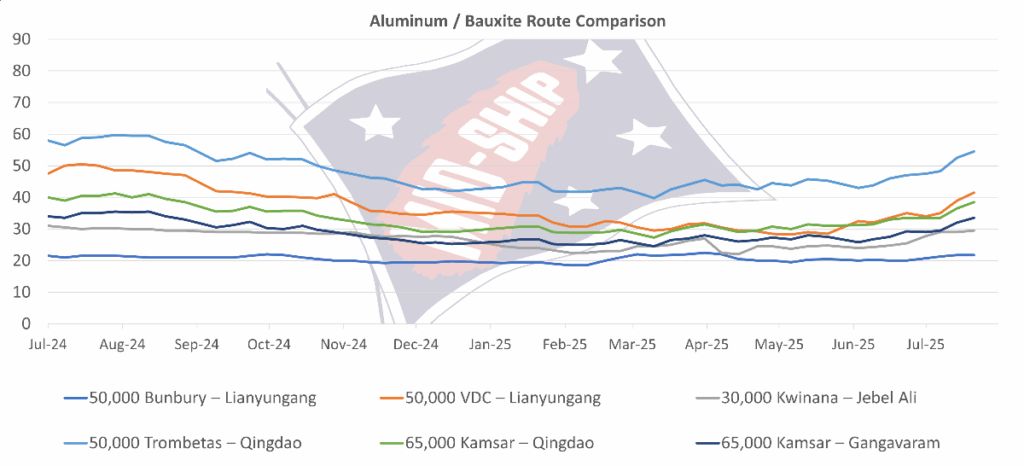
MID-SHIP Alumina/Bauxite – August 26, 2025

August 26, 2025

Market Overview: 

We ended the week for Capes 180,000 DWT on Friday August 15th at $27,323 (down from $27,716 the prior Friday). The market was down slightly throughout the trading week, with reoccurring theme of an uptick from Thursday to Friday similar to the prior week. On Monday, last week we were at $26,638 (down from $27,506 a week prior). The average was $23,778 down from $27,206 by mid-week and ending the week at $23,160 (down from $27,323 the Friday before). The Time Charter Average starts this week at $25,140. Tuesday’s FFA forward curve points to August at $25,917 (down from $26,425). September is assessed at $28,783 (up from $27,021 a week ago). Q3 is assessed at $25,568 (up from $25,151), and Q4 at $27,068 (from $26,164), indicating some improvement to come in the Cape market for the year’s balance. This market is heavily influenced by China, where things are currently tough. The benchmark Brazil to China voyage was mixed through the week and stands at $24.72 – up a tick from $24.50 to start the new trading week.

The Panamax market was improved last week and traded within a narrow range last week and improved to start the new week. The Trans-Atlantic round is currently assessed at $17,855 (up from $15,318). In the Pacific, a round voyage for a Baltic type is estimated at $14,402 (up a bit from $14,000 last week). On Friday, August 15th, the time charter average traded at $14,601. The daily time charter average started last week at $14,673 (up a bit from $14,529) inched up a bit to $14,985 by mid-week and ended the week at $15,932 (up from $14,601) on Friday. The spot average is up a tick on Tuesday, to start the new week at $16,363 from $14,673. The forward curve shows optimism for September, with August assessed at $15,174 (up from $14,802). The forward curve moves through the year’s balance, indicating $17,644 up from $15,407 for September. Q3 is estimated at $16,657 up from $15,787 and Q4 2025 paper at $16,204 also up from $15,227 last week.

The Supramax market again moved along a narrow range last week and up nicely to start the new week. We started last week’s physical market with the Supra 63 at $17,207 (up from $16,745 one week prior). The segment moved to $17,550 up from $16,887 at mid-week and ended the week at $17,994 (up from $17,100); this Tuesday, we are at $18,165 up from $17,207 to start the new week. We start the week with the benchmark front haul rate in the market (U.S. Gulf to Asia) for the Supra 63 assessed at $28,454 (from $27,036) and trading in the physical market as firmer numbers. The August paper for the average of the time charter routes is assessed at $17,224 (up a bit from $17,042); September is estimated at $19,042 up substantially from $15,407 last week); Q3 is assessed at $17,250 (up from $15,787); and Q4 is estimated at $17,185 up from $15,227 last week.

The Handy-size market moved up last week. The daily average rates moved from $12,635 to $13,054 – up from $12,336 to $12,570 last week, and we start the new week at a better $13,236 (up from $12,635). The trip from the U.S. Gulf to Europe was up nicely week over week at $17,721 (up from $16,457 compared to last week’s and $14,468 two weeks ago). The spot physical market continued more volatile positionally to the upside. The forward curve of the average of the time charter daily routes points to slightly lower levels to end August and then better levels – August is assessed at $12,763, September at $14,113 (up from $13,513). The Q3 assessment indicates $12,913 (from $12,725) and Q4 at $ 13,334 (up from $12,275).

Overall, the market is more optimistic at the start of the new week.


Subscribe below to receive the full report.

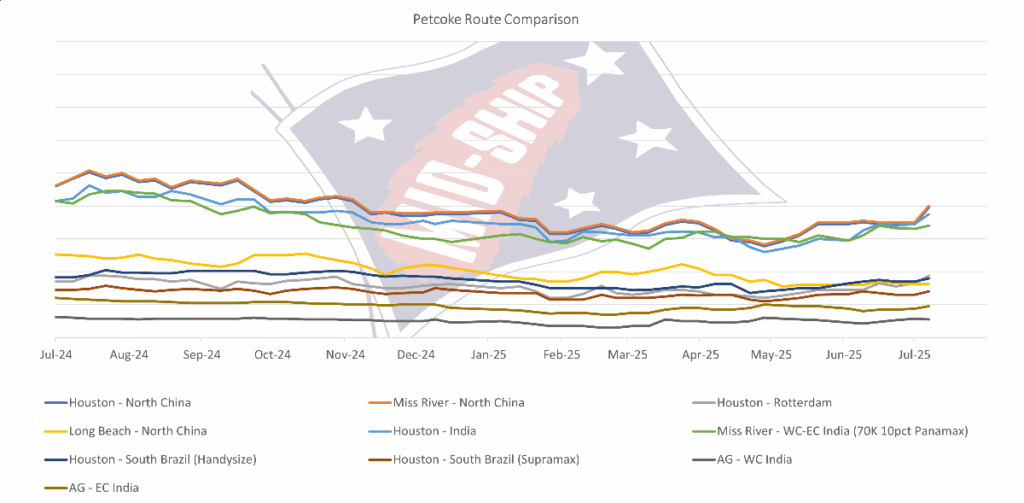
MID-SHIP Petcoke Report – August 18, 2025

August 18, 2025

Market overview:  

We ended the week for Capes 180,000 DWT on Friday, August 8, at $27,716 (up from $27,331 the prior Friday). The market was down slightly throughout the trading week, but ended on an uptick from Thursday to Friday, similar to the prior week. On Monday, last week, we were at $27,506 (down from $31,296 a week prior). The average was $27,206 by mid-week and ended the week at $27,323. The Time Charter Average starts this week at $26,638. Monday’s FFA forward curve points to August at $26,425 (relatively flat compared to a week ago $26,413). September is assessed at $27,021, up from $26,483 a week ago. Q3 is assessed at $25,151, and Q4 at $26,164, indicating a relatively flat Cape market for the year’s balance. This market is heavily influenced by China, where things are currently tough. The benchmark Brazil to China voyage was mixed through the week and stands at $24,50 to start the new trading week (down from $25,00 the prior week).

The Panamax market was mixed last week and traded within a narrow range. The Trans-Atlantic round is currently assessed at $15,318 (similar to the prior week’s $15,459). In the Pacific, a round voyage for a Baltic type is estimated at $14,000, up from $13,293 last week. On Friday, August 8, the time charter average traded at $14,712, almost the same as the $14,798 a week earlier. The daily time charter average started last week at $14,529 (down from $14,696), inched down a bit to $14,342 (down from $14,791 7 days earlier) by mid-week, and ended the week at $14,601 on Friday (down from $14,712 a week earlier). The spot average is up a tick on Monday, to start the new week at $14,673. The forward curve shows slight optimism, with August assessed at $14,802. The forward curve moves through the year’s balance, indicating $15,407 for September. Q3 is estimated at $15,787, and Q4 2025 paper at $15,227.

The Supramax market again moved along a narrow range and up slightly last week. We started last week’s physical market with the Supra 63 at $16,745 (up from $16,051 one week prior). The segment moved to $16,887 at mid-week and ended the week at $17,100; this Monday, we are at $17,207 to start the new week. We start the week with the benchmark front haul rate in the market (US Gulf to Asia) for the Supra 63 assessed at $27,036 and trading in the physical market as firmer numbers. The August paper for the average of the time charter routes is assessed at $17,042, up a bit from $16,726; September is estimated at $15,407, down from last week’s assessment of $16,809; Q3 is assessed at $15,787 (down from $16,340); and Q4 is estimated at $15,227 down slightly from last week’s $15,425.

The Handy-size market moved sideways to up last week. The daily average rates moved from $12,336 to $12,570 (up a bit from last week’s $12,170 to $12,294), and we start the new week at a better $12,635. The trip from the US Gulf to Europe was up nicely week over week at $16,457 compared to last week’s $14,468. The spot physical was more volatile and positionally firmer. The forward curve of the average of the time charter daily routes points to slightly better levels – August is assessed at $12,800, September at $13,513. The Q3 assessment indicates $12,725, and Q4 at $12,275.

Overall, the market is more optimistic at the start of the new week.


Subscribe below to receive the full report.


MID-SHIP Cement Report – August 11, 2025

August 11, 2025

Market Overview: 

A slow start to the week for Cape-size, with Sentiment sluggish ahead of the USA/Russia Summit this week. Panamax trades within a narrow range within both basins, maintaining a fine balance between vessel supply and cargo inquiries nearby. Supra/Ultra’s, like Panamax, are trading firm within a narrow range, with an improved USG front haul, while East Coast South is less exciting. Handysize maintains a “steady as she goes” tone, with a good balance of ships to cargoes.

As of last week, 90% of S&P 500 companies reported. Of these companies, 81% reported both positive earnings and revenue surprises. Currently, the earnings growth rate for the S&P 500 is 11.8%.

July Core CPI inflation, reported this morning in the USA, was 2.7%, lower than expected but still concerning. The Consumer Price Index measures the cost of goods and services from the consumer’s perspective. Bias towards interest rate easing in September continues to be the discussion.

2 dead and 10 injured in U.S. Steel plant in Clairton, Pennsylvania — the largest Coke-making facility in the USA. Investigators are probing the cause of the explosion. Thoughts and prayers go out to all the families affected by this terrible accident.


Subscribe below to receive the full report.

MID-SHIP Fertilizer – August 4, 2025

August 4, 2025

Market Overview:

The Cape market was off almost $4,500 daily on the time charter average to end the week-over-week trading. Panamax was softer. Supra’s down in a narrow range. Handy-sizes continue in full-blown summer mode, lacking luster, trading down in a narrow range.

Last week was a busy week for U.S. Trade negotiations. The U.S. imposed 25% tariffs on India starting August 1, coupled with unspecified penalties for its continued purchase of Russian energy. On July 28, it was reported that President Trump planned secondary tariffs and sanctions on Russia to take effect in 12 days unless the Ukraine conflict ends, with severe penalties for countries importing Russian oil. US-China trade negotiations ended without a new deal by July 29, leaving two weeks to extend a deadline or face the resumption of historically high tariffs, with current rates at 30% for the U.S. and 10% for China after a temporary truce. On July 31, President Trump signed an order pausing higher tariffs on Mexico for 90 days, providing temporary relief as trade negotiations continue. President Trump signed an executive order for new tariffs ranging from 10% to 41% on 69 countries, effective August 7, further reshaping global trade dynamics.

This week, new U.S. “reciprocal” tariffs are set to take effect on August 7, with most trading partners facing 15-20% tariffs on exports to the U.S., while countries like India and South Africa could see higher rates (up to 30%), potentially escalating trade tensions. The U.S. is expected to raise tariffs on India to 30% this week due to its continued purchase of Russian oil, risking strained relations with a key partner unless trade negotiations yield a last-minute deal. Switzerland is anticipated to finalize a new trade agreement with the U.S. to counter a proposed 39% tariff, with talks likely intensifying this week to avoid economic fallout. Russian President Vladimir Putin is facing a U.S. Government sanctions ultimatum expiring this Friday.

For the stock market, with the August 7 deadline for U.S. trading partners to adjust currency practices or face higher tariffs, global markets are expected to remain volatile, potentially losing significant market cap as seen in recent weeks.


Subscribe below to receive the full report.

MID-SHIP Fertilizer – July 29, 2025

July 29, 2025

Market Overview:

Summertime is in full swing. It was a quiet start to the week, with limited activity reported across both the Atlantic and Pacific basins. Capes are looking for direction. Panamax, Supra, and Handy suffer from a growing vessel list nearby. It has become a three-day trading market, from Tuesday to Thursday.

Top U.S. and Chinese economic officials will resume talks in Stockholm today, “aiming to extend [an economic] truce by three months and keeping sharply higher tariffs at bay”, according to Reuters. China is facing an August 12 deadline to reach a durable tariff agreement with President Donald Trump’s administration, after Beijing and Washington reached preliminary deals in May and June to end weeks of escalating tariffs and a cut-off of rare earth minerals.

Trump and European Commission President Ursula von der Leyen emerged from an hour-long discussion on Sunday with a trade agreement between the U.S. and EU, successfully fending off the president’s threat to slap a 30% tariff on EU-made goods that was due to take effect this coming Friday. Key sectors like autos, semiconductors, aircraft components, chemicals, and generics are exempted under “zero for zero” rules.

Adding to the good news, on Monday morning, President Trump indicated that the baseline universal tariff rate for many partners may fall from 20% to around 15%, easing pressure on trade across the board.

Overall, with the August 1 trade deadline looming for multiple partners, these developments tilt the picture slightly bullish: trade risk is receding, and greater clarity is emerging ahead of key shutdown dates.

The U.S. Dollar just had its worst first half of the year since 1973. It fell about 11% through the end of June compared with other global currencies. As a result, according to a recent European Central Bank report, gold is now the second-largest central-bank holding in the world. (The U.S. dollar remains No. 1, at 47% of bank stores.)

Understand last week a handy size stem Ferts cargo from USG to Brazil basis 1-2 was fixed in the upper 20’s pmt. ICEC was out with a Supramax stem size ferts cargo this week from Vancouver to CHOPT, USG or Brazil. Gathering further details on what rate levels charterers eventually fixed but other operators feel the time charter equivalent is around USD 13k-14k per day basis delivery APS.

Trump’s tariff deadline is on Friday.


Subscribe below to receive the full report.

MID-SHIP Alumina/Bauxite – July 21, 2025

July 21, 2025

Market Overview: 

The summer season is in full swing, and many decision makers have been off on holidays in recent weeks and are expected to be in the coming weeks.

The Cape-size market continued its positive momentum last week and continued in the new trading session at the start of this week. Panamax markets were mixed. Supra/Ultras were up nicely across both basins. Both Panamax and Supras appear to have lost some momentum at the start of the new week. Handy-size markets traded up within a narrow range.

China’s National Energy Administration has ordered coal mines exceeding production capacity to suspend operations for rectification, boosting coal stock prices and signaling tighter supply controls. Iron ore and steel prices hit a four-month high, driven by optimism from China’s launch of a $167 billion hydropower dam project on the Yarlung Tsangpo River and efforts to address steel overcapacity. The Ministry of Industry and Information Technology announced a new program to stabilize growth by eliminating outdated capacity in 10 key industries, including steel and petrochemicals.

The U.S. Treasury Department announced that business equipment production in the U.S. is up nearly 17% annually through the first half of the year—the fastest pace since 1997.

The Trump administration has set August 1, 2025, as the deadline for imposing higher “reciprocal” tariffs on countries that fail to negotiate trade deals, following a 90-day pause on tariffs announced in April. The Trump administration has threatened secondary tariffs of 100% on countries like China and India if they continue to buy Russian oil and gas, with a deadline of September 2, 2025, to pressure Russia into a Ukraine peace deal. The U.S. has also paused reciprocal tariffs on China, reducing them from 145% to 30% for 90 days starting May 14, 2025, to facilitate trade talks, though the 20% fentanyl-related tariff remained.

We anticipate stable freight rates through the summer, with positional volatility nearby. They will likely increase in mid- to second-half September as the Northern Hemisphere’s grain export season begins and U.S. exports to various markets remain strong amid ongoing China trade negotiations. Senior U.S. administration officials project a 3%+ growth rate later this year, signaling positive prospects for global markets. Following early 2025 disruptions, a robust U.S. economy could uplift global trade.


Subscribe below to receive the full report.


MID-SHIP Petcoke Report – July 14, 2025

July 14, 2025

Market overview:  

The Capesize market commenced the week on a positive note, despite relatively subdued activity levels. The BCI 5TC recorded a significant increase of $2,180, reaching $19,633, indicating robust sentiment across both the Atlantic and Pacific basins. The Panamax and Supramax segments maintained their upward momentum at the week’s outset, supported by strong demand in the US Gulf and East Coast South America regions. Meanwhile, the Handyside market exhibited signs of revitalization, with more robust trading activity observed in Asia.

The U.S. Administration increased trade tensions again by announcing a 30% tariff on imports from the EU and Mexico, effective August 1st. On July 14, 2025, President Trump threatened to impose 100% secondary tariffs on countries and companies purchasing Russian exports (particularly oil, gas, and uranium) if Russia does not reach a peace agreement with Ukraine within 50 days (by approximately September 2, 2025). These tariffs would affect major Russian oil buyers like China, India, Brazil, and Turkey, as well as some EU countries such as Hungary, Slovakia, and the Czech Republic.

The new U.S. legislation (OBBB) phases out tax credits for wind and solar, which may diminish their economic edge over coal. It also adds metallurgical coal that’s used to make steel to the list critical minerals qualifying for tax credits.

Our market, while relatively firm for mid-July and the summer season, is once again in a wait-and-see mode, with expectations of potential shifts due to geopolitical and economic factors, resulting from renewed tariff complexity this week.


Subscribe below to receive the full report.

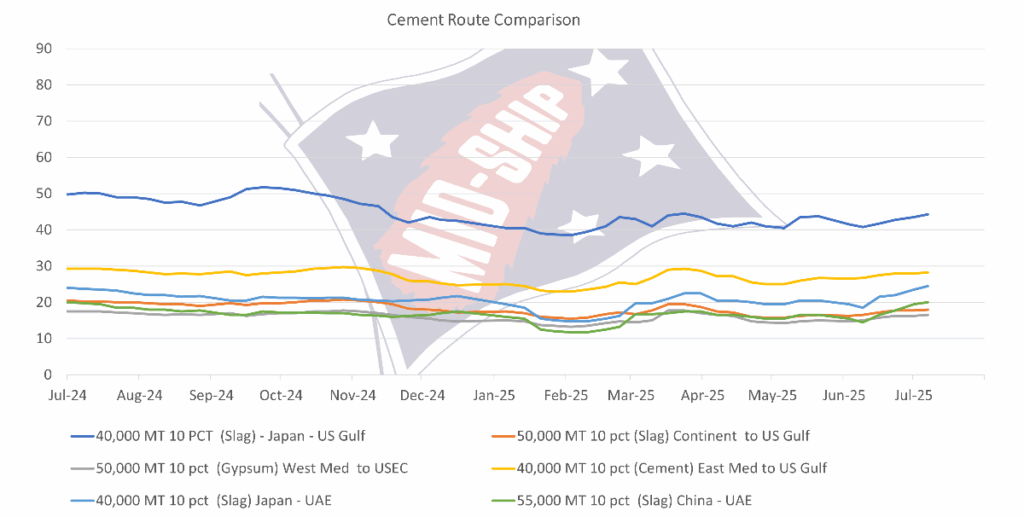
MID-SHIP Cement Report – July 7, 2025

July 7, 2025

Market Overview: 

Our heartfelt thoughts and prayers are with all those who have tragically lost their lives and loved ones and those profoundly affected by the recent flash floods in Texas. The devastation caused by this natural disaster is deeply saddening, and we stand in solidarity with the affected communities during this challenging time.

The Baltic Dry Index, which tracks dry bulk freight rates, rose slightly to 1,436 Index Points on July 4, 2025, but has fallen 11.69% over the past month and 26.96% compared to the same time last year.

Two sailors were killed in the Monday Red Sea attack on the Eternity C. This second attack in as many days came just hours after the Houthis claimed responsibility for the Sunday attack on the vessel Magic Seas. The incident marked the first fatalities from Red Sea attacks in over a year as Yemen’s Houthis resume operations. Later in the day, the Israeli air force hit Houthi targets across Yemen.

This week, the U.S. trade Negotiations continue. President Trump established August 1 to impose reciprocal tariff rates on many U.S. trading partners, making public letters sent to Japan and Korea, and informing the administration that it is sending letters to various countries warning them of coming levies.

Our market is basically in a wait-and-see mode during the summer season, with expectations of potential shifts due to geopolitical and economic factors.


Subscribe below to receive the full report.